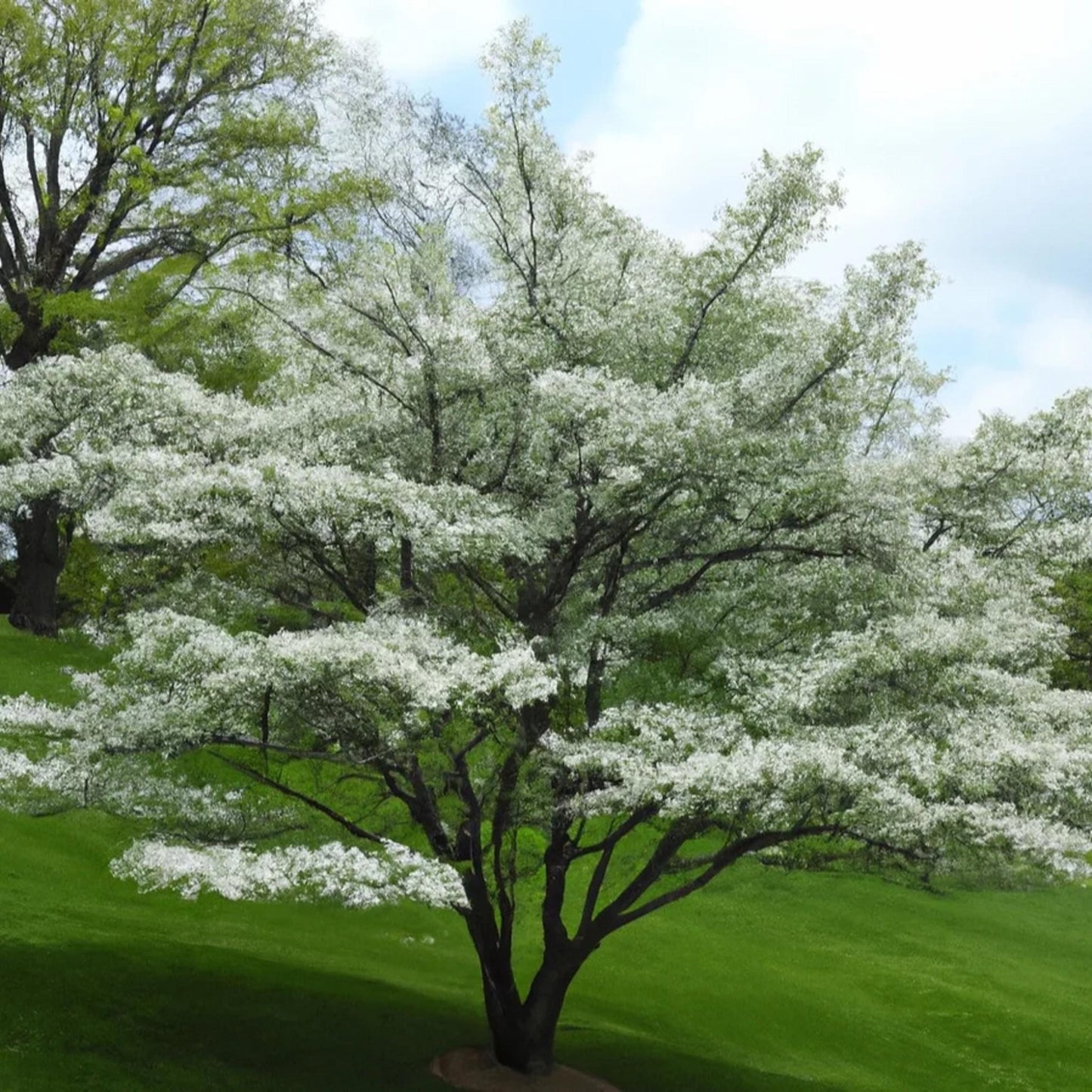


White Flowering Dogwood Tree Seeds | (Cornus florida)
White Flowering Dogwood Tree Seeds | (Cornus florida)
The tree that announces spring. The most beloved flowering native tree in the South.
Cornus florida, the White Flowering Dogwood, is the defining spring flowering tree of eastern North America, its four white bracts opening flat and wide at eye level before the leaves emerge, creating a horizontal layered display that is unlike any other tree in the forest. It grows as a natural understory tree beneath the canopy of larger hardwoods, which means it thrives in the filtered light conditions that challenge other flowering trees. In fall its foliage turns deep burgundy-red and its glossy red berries provide wildlife food into winter. If you are looking to buy Dogwood seeds or grow flowering dogwood from seed, this is the native tree that transforms a yard into something that stops people in their tracks every April.
- Four white bracts opening flat and wide in early spring before leaves emerge, creating a layered horizontal display
- Native understory tree that thrives in partial shade beneath existing canopy
- Deep burgundy-red fall foliage and persistent glossy red berries through fall and winter
- Host plant for Spring Azure butterfly and several native moth species
- One of the most widely loved native flowering trees in North American horticulture
Things you probably did not know about the White Flowering Dogwood
The white petals are not petals at all.
What appears to be the four white flowers of a Dogwood bloom are actually modified leaves called bracts. The actual flowers are the tiny cluster of yellow-green structures at the center of each bract arrangement. The bracts evolved not to attract pollinators directly but to make the small central flowers visible to insects from a distance.
The berries are eaten by over 36 bird species.
Dogwood berries ripen in fall and are consumed by a wide range of migratory birds including robins, thrushes, bluebirds, and wood thrushes, which fuel up on the fat-rich berries before and during migration. Studies of migratory bird diet have consistently ranked Dogwood among the most important native fruit-producing trees for fall migration along the Atlantic flyway.
The wood is the hardest of any common North American tree.
Dogwood wood has a Janka hardness of 2,150, harder than hickory, and was historically used for applications requiring extreme hardness in a small piece. Weaver's shuttles, wooden mallets, tool handles, and golf club heads were made from Dogwood. The wood is so hard it was called the pegwood in the 19th century because it was used for the pegs in wooden machinery.
It has been under stress for decades and is making a comeback.
Dogwood anthracnose, a fungal disease that arrived in the 1970s and spread rapidly, killed millions of native Dogwoods across the Appalachians through the 1980s and 1990s. Breeding programs have developed resistant selections and natural resistance has begun appearing in wild populations. The Dogwood forests of the East are slowly recovering.
Growing Details
- Botanical Name: Cornus florida
- Stratification: Required, 60 days warm followed by 90 days cold stratification
- USDA Zones: 5 to 9
- Soil: Well-drained, moist, acidic, rich in organic matter
- Light: Full sun to partial shade, best bloom in morning sun with afternoon shade
- Height: 15 to 30 feet
- Spread: 20 to 30 feet
- Growth Rate: Slow, 6 to 12 inches per year
Plant it at the edge of the woods or anywhere that gets filtered afternoon shade. You will look forward to April differently once it is in the ground.
FAQ
FAQ
Do you pre-stratify the seeds?
Most of our seeds are not pre-stratified. They are stored under dry, cold conditions to preserve viability without initiating stratification, allowing you to time germination for your local growing season.
The exception is recalcitrant seeds. Because these seeds must remain moist to stay viable, they are kept in moist, cold storage and are therefore in a pre-stratified state. Depending on how long a particular batch has been stored, some may arrive with an emerging radicle and be ready to plant immediately. Radicle development is not guaranteed.
Please refer to the individual product page and included growing instructions for species-specific requirements.
Do any of your seeds need to stay moist? (Recalcitrant seeds)
Yes. Some species we offer, including Chestnut, Hazelnut, and Paw Paw, are recalcitrant and must remain moist to stay viable.
Please refrigerate these seeds immediately upon arrival unless they have already developed a radicle. Seeds with an emerging radicle should be planted promptly.
Do you ship internationally?
No. We currently ship within the United States only.
We previously shipped to Canada, but tariffs, duties, and import fees resulted in customers receiving significant and unpredictable additional charges upon delivery. Because we cannot reliably calculate or absorb these costs, we have suspended shipping to Canada.
At this time, we do not ship to Canada or other international destinations.
Shipping & What's Included
Shipping & What's Included
Shipping & Packaging
• Hand-packed in resealable kraft paper seed bags
• Stratification and planting instructions included on every seed pack
• Ships within 3–5 business days via USPS within the United States and U.S. territories
Return Policy
Return Policy
Due to the nature of our products, we do not accept returns on seeds.
If your order arrives damaged, contains incorrect items, or is missing items, please contact us within 7 days of delivery so we can resolve the issue.