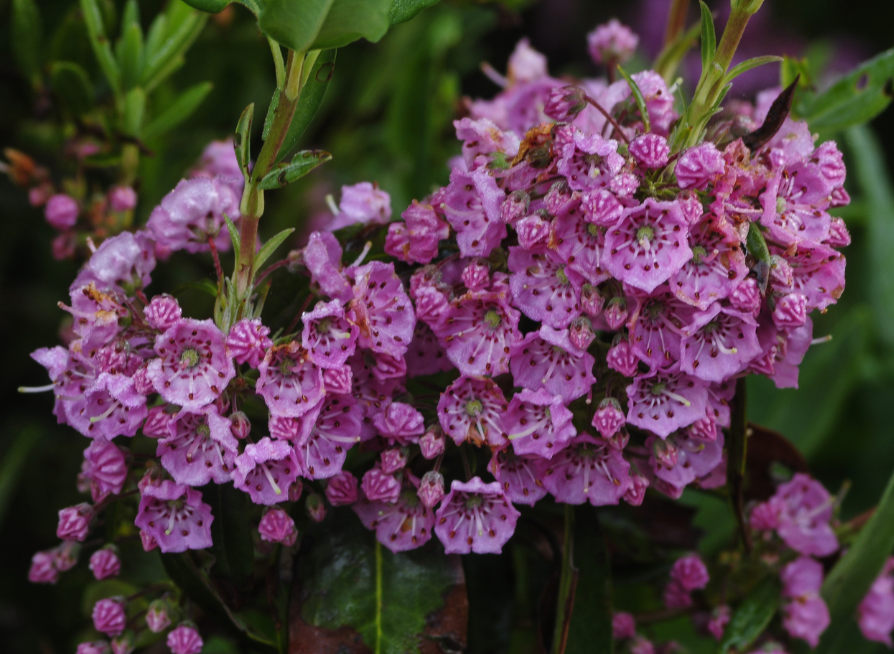


Sheep Laurel Tree Seeds | Lambkill | (Kalmia angustifolia)
Sheep Laurel Tree Seeds | Lambkill | (Kalmia angustifolia)
Small enough to overlook. Vivid enough to stop you cold.
Kalmia angustifolia, the Sheep Laurel or Lambkill, is a compact, evergreen native shrub of the northeastern United States and eastern Canada that produces one of the most intensely colored flowers of any low-growing shrub in the temperate flora, tight clusters of deep rose-pink to magenta saucer-shaped blooms with the distinctive geometric precision that defines the Kalmia genus, each flower a perfect five-pointed cup marked with ten small stamens held under tension in pockets of the petals until a visiting insect triggers their release in a burst of pollen. The plant grows naturally in acidic bogs, rocky heathlands, barrens, and open boreal forest understories where soils are thin, cold, and nutrient-poor, forming dense, spreading colonies of narrow evergreen leaves that remain on the plant through the harshest northern winters. It is smaller and more restrained in scale than its well-known relative Mountain Laurel, fitting naturally into rock gardens, acidic borders, native plantings, and heath gardens where its year-round evergreen presence and spectacular late spring bloom earn it a permanent place. If you are looking to buy Sheep Laurel seeds or grow Kalmia angustifolia from seed, this is the native broadleaf evergreen that thrives in the difficult, acidic conditions where most ornamental plants refuse to grow and rewards that patience with bloom color that few shrubs at any size can match.
- Deep rose-pink to magenta flower clusters bloom in late spring to early summer, producing some of the most intensely saturated color of any native shrub in its size range
- Narrow, evergreen foliage provides year-round structure and dark green presence in acidic, low-nutrient soils and exposed northern gardens
- Naturally spreads by layering and suckering to form dense, weed-suppressing colonies over time in suitable conditions
- Exceptional cold hardiness to Zone 1 in established plantings, making it among the most frost-proof broadleaf evergreens in cultivation
- Native to eastern North America and provides nectar for specialist native bees, bumblebees, and early-season pollinators
Things you probably did not know about Sheep Laurel
The stamens of Kalmia flowers are held under spring tension inside small pockets in the petals and release explosively when triggered by a visiting insect. In the unopened flower, each of the ten stamens bends outward and locks its anther into a small pouch formed by the corolla, storing elastic energy in the curved filament the way a bent spring stores mechanical energy. When a bee lands on the flower and its weight or probing tongue contacts a stamen, the filament releases, catapulting the anther forward and dusting the insect with pollen in a fraction of a second. This mechanism ensures cross-pollination by physically loading visiting pollinators with pollen and has been studied as one of the more elegant mechanical adaptations in flowering plant reproduction.
The common name Lambkill reflects a genuine and well-documented toxicity to sheep and other livestock that browse the foliage. Like all members of the genus Kalmia, Sheep Laurel contains grayanotoxins throughout its leaves, stems, and flowers, compounds that disrupt sodium ion channels in cell membranes and can cause serious poisoning in livestock, particularly sheep and goats that consume the foliage when preferred browse is scarce in early spring before other vegetation has leafed out. The name Lambkill was applied by early settlers who observed the effects on young animals, and the toxicity is real enough that it has historically influenced land management decisions in areas where Kalmia angustifolia forms dense pasture-edge thickets. The plant is not hazardous to wildlife in normal foraging conditions but should not be planted where livestock have access.
Kalmia angustifolia is one of the few broadleaf evergreen shrubs capable of surviving and thriving at the margins of the boreal forest in truly arctic-adjacent conditions. Its natural range extends north into Labrador and Newfoundland, where it grows in open, wind-exposed heathlands subject to temperatures that eliminate virtually every other broadleaf evergreen in the North American flora. The narrow leaves reduce surface area and water loss during frozen winters when root uptake is impossible, and the plant's low, dense habit allows it to remain insulated beneath the winter snowpack. This cold adaptation makes it uniquely valuable for gardeners in Zone 3 and Zone 4 who want a broadleaf evergreen with genuine flowering interest and cannot rely on species with more limited cold tolerance.
Seed germination in Kalmia angustifolia requires specific conditions and is slower and more demanding than most native shrubs. The seeds are extremely fine, similar in scale to rhododendron seed, and require light for germination, making surface sowing on a moist, acidic medium essential. Germination is most reliable at cool to moderate temperatures between 60 and 70 degrees Fahrenheit, and the seedlings are initially tiny and slow-growing, requiring careful attention to moisture and acidic conditions through the first growing season. First-year plants are best grown on in containers with acidic, low-fertility mix before transplanting, and patience is required as Kalmia angustifolia builds its root system before putting on significant top growth.
Growing Details
- Botanical Name: Kalmia angustifolia
- Seed Treatment: Surface sow on moist, acidic medium; seeds require light for germination; no stratification required but cool germination temperatures of 60 to 70 degrees Fahrenheit produce best results
- USDA Zones: 1 to 6
- Soil: Acidic, well-drained to moist, nutrient-poor soil with pH 4.5 to 5.5; peat-based or sandy soils ideal; will not tolerate alkaline or heavily fertilized conditions
- Light: Full sun to partial shade; most compact habit and heaviest flowering in full sun
- Height: 1 to 3 feet
- Spread: 2 to 4 feet, spreading slowly by layering and suckering to form colonies
- Growth Rate: Slow; 3 to 5 years to first significant flowering from seed
Plant it in the poorest, most acidic soil you have, in full sun, and resist every instinct to improve conditions or fertilize. Sheep Laurel was shaped by thousands of years in thin, cold, nutrient-starved ground, and that is exactly the environment in which it will give you the most vivid, most generous bloom it has to offer.
FAQ
FAQ
Do you pre-stratify the seeds?
Most of our seeds are not pre-stratified. We ship them unstratified so you can control germination timing based on your local growing season. We sell to all 50 U.S. states and Canadian provinces, and since each region has different planting windows, pre-stratifying would risk seeds germinating in transit or before you're ready to plant.
True stratification requires cold, moist conditions, which can lead to premature sprouting or mold if not timed properly. To avoid this, we store most seeds in dry cold conditions to preserve viability — but this does not initiate stratification.
Do any of your seeds need to stay moist? (Recalcitrant seeds)
Yes — some species we offer are recalcitrant, meaning they must remain moist to stay viable and cannot be dried out. Examples include: Chestnut, Hazelnut, Paw Paw, etc.
These seeds are shipped in moist cold storage and are clearly labeled on the product page when applicable. Please refrigerate immediately upon arrival and follow included care instructions.
Do you ship internationally?
We currently ship to the United States and Canada only. Unfortunately, we cannot ship to other countries without a phytosanitary certificate, which is required by most international customs agencies.
If you're interested in shipping outside North America, please contact us. Note that a phytosanitary certificate typically adds $60–$80 USD per seed type and must be arranged in advance.
Shipping & What's Included
Shipping & What's Included
Shipping & Packaging
Hand-packed in resealable zipper kraft paper seed bags
Stratification and planting instructions included with every order
1 free bonus seed pack included with every order
Ships within 3–5 business days via USPS
Return Policy
Return Policy
Due to the nature of our products, we do not accept returns on seeds.
However, if your order arrives damaged or incorrect, please contact us within 7 days and we’ll make it right.