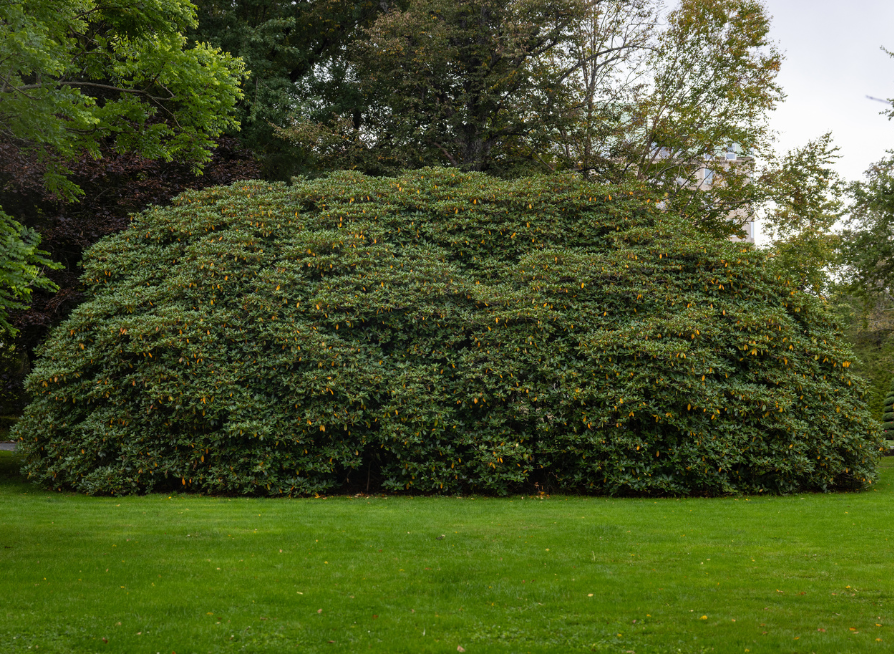


Rosebay Rhododendron Tree Seeds | Great Laurel | (Rhododendron maximum)
Rosebay Rhododendron Tree Seeds | Great Laurel | (Rhododendron maximum)
No other native shrub commands a forest understory like this one.
Rhododendron maximum, the Rosebay Rhododendron or Great Laurel, is the largest native rhododendron in North America, a massive, multi-stemmed evergreen shrub or small tree that forms impenetrable thickets along mountain streams and shaded slopes from Nova Scotia to Georgia, with some of the most spectacular stands found in the southern Appalachians where it grows beneath hemlocks and hardwoods in dense, cathedral-like groves. The leaves are large, dark, and leathery, remaining on the plant through even the harshest winters and curling tightly in extreme cold before unfurling again as temperatures rise, a reliable natural thermometer recognized by generations of Appalachian woodspeople. In late spring to early summer, established plants erupt in large trusses of white to pale pink flowers spotted with yellow-green, blooming later than most rhododendrons and extending the season when others have already finished. It is shade-tolerant to a degree unusual among flowering shrubs, thriving beneath a closed forest canopy where few ornamental plants can perform. If you are looking to buy Rosebay Rhododendron seeds or grow Rhododendron maximum from seed, this is the native giant that brings year-round presence, wildlife value, and breathtaking bloom to woodland gardens and shaded landscapes.
- Large trusses of white to pale pink flowers with yellow-green spotting bloom in late spring to early summer, later than most rhododendrons
- Bold, evergreen foliage up to 12 inches long provides dramatic year-round structure in shaded and woodland settings
- Exceptional shade tolerance allows it to thrive under closed forest canopies where other flowering shrubs fail
- Native to eastern North America and provides critical nesting cover and winter shelter for birds and wildlife
- Cold hardy to Zone 3 in established plantings, making it one of the hardiest large-leaved evergreen shrubs available
Things you probably did not know about Rosebay Rhododendron
The leaf-curling behavior of Rhododendron maximum in cold weather is a well-documented physiological response to freezing temperatures, not damage. As temperatures drop toward and below freezing, the large leaves roll lengthwise into tight cylinders and droop downward, a response that reduces the surface area exposed to desiccating winter wind and minimizes water loss through the leaf surface when frozen ground prevents root uptake. The tighter and more drooped the leaves, the colder the temperature, and experienced Appalachian outdoorspeople have long used the degree of curl as a rough field thermometer. As temperatures rise above freezing the leaves unroll and resume their normal posture within hours, fully undamaged.
Rosebay Rhododendron thickets, known as rhododendron hells, were a genuine navigational and survival hazard for early Appalachian explorers. In the southern Appalachians, Rhododendron maximum forms near-impenetrable stands that can cover hundreds of acres on steep, rocky slopes along mountain streams. The interlocking branches grow at irregular angles, creating a dark, maze-like interior that early surveyors and settlers described as nearly impossible to traverse. The term rhododendron hell was used without exaggeration in 19th-century accounts of travel through western North Carolina and Tennessee, and the density of some historic stands was sufficient to cause travelers to become genuinely disoriented.
The plant contains grayanotoxins throughout its tissues, making it toxic to livestock and producing documented cases of honey poisoning. All parts of Rhododendron maximum, including leaves, flowers, and nectar, contain grayanotoxins, compounds that interfere with sodium channels in cell membranes and can cause serious poisoning in livestock, particularly sheep, goats, and cattle that browse the foliage when other food is scarce. Honey produced by bees foraging heavily on rhododendron flowers can concentrate these toxins, producing what has been documented since ancient times as mad honey, a phenomenon recorded by Xenophon in 401 BC when his soldiers were incapacitated after eating honey near a stand of Rhododendron ponticum in the mountains of what is now Turkey.
Rhododendron maximum plays a documented role in suppressing forest regeneration beneath its canopy. Research in the southern Appalachians has shown that dense Rosebay Rhododendron thickets significantly reduce light penetration to the forest floor, intercept rainfall before it reaches the soil, and release allelopathic compounds that inhibit the germination and growth of competing plants. In hemlock forests heavily affected by hemlock woolly adelgid, the death of overstory hemlocks has in some areas led to Rhododendron maximum expanding aggressively to fill the gap, creating conditions that delay or alter the recovery of diverse forest understory communities.
Growing Details
- Botanical Name: Rhododendron maximum
- Seed Treatment: Surface sow on moist, acidic medium; no stratification required but cool, moist conditions of 40 to 50 degrees Fahrenheit for 4 to 6 weeks can improve germination uniformity; seeds are extremely fine and require light to germinate
- USDA Zones: 3 to 7
- Soil: Moist, acidic, well-drained, humus-rich soil with pH 4.5 to 6.0; mulch heavily to retain moisture and keep roots cool
- Light: Partial to full shade; tolerates deep shade better than almost any other large flowering shrub
- Height: 8 to 15 feet, occasionally to 30 feet in ideal conditions
- Spread: 8 to 15 feet, forming broad, multi-stemmed colonies over time
- Growth Rate: Slow; patience required, 5 to 7 years to first bloom from seed
Plant it at the woodland edge or beneath tall trees where shade is deep and the soil stays cool and moist. Give it years rather than seasons, mulch the roots every spring, and keep the soil acidic. The Rosebay Rhododendron was here long before the gardens we plant it in, and given the right conditions, it will outlast them too.
FAQ
FAQ
Do you pre-stratify the seeds?
Most of our seeds are not pre-stratified. We ship them unstratified so you can control germination timing based on your local growing season. We sell to all 50 U.S. states and Canadian provinces, and since each region has different planting windows, pre-stratifying would risk seeds germinating in transit or before you're ready to plant.
True stratification requires cold, moist conditions, which can lead to premature sprouting or mold if not timed properly. To avoid this, we store most seeds in dry cold conditions to preserve viability — but this does not initiate stratification.
Do any of your seeds need to stay moist? (Recalcitrant seeds)
Yes — some species we offer are recalcitrant, meaning they must remain moist to stay viable and cannot be dried out. Examples include: Chestnut, Hazelnut, Paw Paw, etc.
These seeds are shipped in moist cold storage and are clearly labeled on the product page when applicable. Please refrigerate immediately upon arrival and follow included care instructions.
Do you ship internationally?
We currently ship to the United States and Canada only. Unfortunately, we cannot ship to other countries without a phytosanitary certificate, which is required by most international customs agencies.
If you're interested in shipping outside North America, please contact us. Note that a phytosanitary certificate typically adds $60–$80 USD per seed type and must be arranged in advance.
Shipping & What's Included
Shipping & What's Included
Shipping & Packaging
Hand-packed in resealable zipper kraft paper seed bags
Stratification and planting instructions included with every order
1 free bonus seed pack included with every order
Ships within 3–5 business days via USPS
Return Policy
Return Policy
Due to the nature of our products, we do not accept returns on seeds.
However, if your order arrives damaged or incorrect, please contact us within 7 days and we’ll make it right.