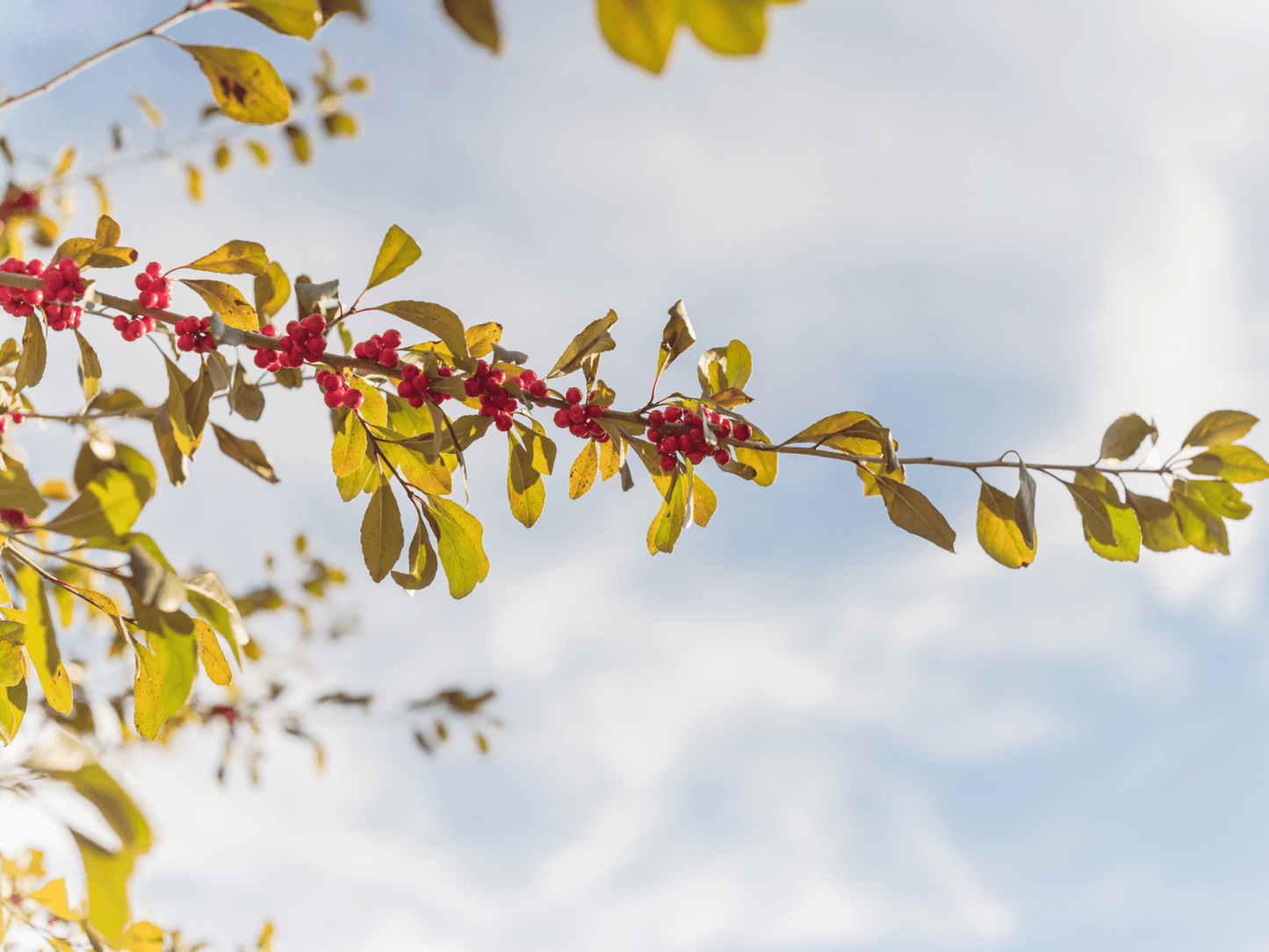


Possumhaw Tree Seeds | Deciduous Holly | (Ilex decidua)
Possumhaw Tree Seeds | Deciduous Holly | (Ilex decidua)
The most prolific red berry display of any native shrub. Bare stems loaded with fire in winter.
Ilex decidua, the Possumhaw or Deciduous Holly, is the winter showstopper of the southeastern native plant world, a deciduous holly that drops its leaves in fall to reveal stems so densely covered in brilliant red to orange-red berries that the shrub appears to be on fire against a gray winter sky. Unlike the evergreen American Holly whose berries are partially hidden by foliage, Possumhaw's berries are fully visible on bare stems throughout the entire winter, creating one of the most sustained and dramatic native wildlife displays available in any temperate garden from November through March. It is native across the southeastern United States and lower Midwest, adaptable to wet and dry soils, sun and partial shade, and produces berries that sustain cedar waxwings, robins, bluebirds, and mockingbirds through the leanest months of winter. If you are looking to buy Possumhaw seeds or grow this native holly from seed, this is the native shrub that defines the winter landscape of the American South.
- Bare stems loaded with brilliant red to orange-red berries from November through March, one of the most vivid winter displays of any native plant
- Berries fully visible without foliage, unlike evergreen hollies whose fruit is partially obscured by leaves
- Native across the southeastern United States and lower Midwest, adaptable to a wide range of conditions
- Critical winter food source for cedar waxwings, American robins, bluebirds, and mockingbirds
- Dioecious, requiring male and female plants for berry production on female trees
Things you probably did not know about the Possumhaw
The berries remain on the stems long after other winter food sources have been consumed. Possumhaw berries are not the first choice of most berry-eating birds in fall when more palatable fruits are available. The birds move to Possumhaw in late winter, often February and March, after preferred berries of American Holly, spicebush, and other species have been exhausted. This delayed consumption pattern means Possumhaw provides food precisely when birds need it most, during the period of deepest winter before spring foraging opportunities develop, making it one of the most strategically timed native food plants in the eastern landscape.
The name Possumhaw reflects historical observations of opossums feeding on the berries. The common name derives from early American naturalists observing Virginia opossums foraging on the berries of this deciduous holly, particularly in the colder months when the fruit represents one of the few reliable food sources accessible to the opossum's non-selective, opportunistic foraging behavior. The opossum connection is reflected in the common names of several southeastern native plants that produce fruit accessible during winter months.
Some Possumhaw populations produce orange or yellow berries rather than red. While the most familiar and most commonly grown Possumhaw selections produce brilliant red berries, natural populations across the southeastern range of the species include individuals with orange, yellow-orange, and occasionally yellow fruit. These color variants have been selected and named in nursery cultivation, with Warren's Red, Council Fire, and Byer's Golden among the commonly available named selections. Seed-grown plants from red parents typically produce red-berried offspring but may occasionally produce color variants.
The berry persistence through winter is a specific adaptation to winter-specialized bird dispersers. Possumhaw evolved to have its berries consumed primarily by winter-resident birds that are present when competing fruit sources have been depleted, a strategy that delays consumption until the timing optimizes seed dispersal into conditions suitable for spring germination. The berries become more palatable to birds after freeze-thaw cycles reduce astringency, explaining why birds show the strongest interest in late winter when the berries have experienced multiple temperature cycles.
Growing Details
- Botanical Name: Ilex decidua
- Stratification: Required, warm stratification of 60 to 90 days followed by 90 to 120 days cold stratification
- USDA Zones: 3 to 9
- Soil: Adaptable, tolerates wet, dry, poor, or clay soils
- Light: Full sun to partial shade
- Height: 7 to 15 feet
- Spread: 5 to 10 feet
- Growth Rate: Moderate, 1 to 1.5 feet per year
Plant at least one male and two or more female plants for maximum berry production and ensure a male is within 50 feet of each female. In February when the birds strip the berries in a single afternoon flock visit you will understand why this plant belongs in every southern native garden.
FAQ
FAQ
Do you pre-stratify the seeds?
Most of our seeds are not pre-stratified. They are stored under dry, cold conditions to preserve viability without initiating stratification, allowing you to time germination for your local growing season.
The exception is recalcitrant seeds. Because these seeds must remain moist to stay viable, they are kept in moist, cold storage and are therefore in a pre-stratified state. Depending on how long a particular batch has been stored, some may arrive with an emerging radicle and be ready to plant immediately. Radicle development is not guaranteed.
Please refer to the individual product page and included growing instructions for species-specific requirements.
Do any of your seeds need to stay moist? (Recalcitrant seeds)
Yes. Some species we offer, including Chestnut, Hazelnut, and Paw Paw, are recalcitrant and must remain moist to stay viable.
Please refrigerate these seeds immediately upon arrival unless they have already developed a radicle. Seeds with an emerging radicle should be planted promptly.
Do you ship internationally?
No. We currently ship within the United States only.
We previously shipped to Canada, but tariffs, duties, and import fees resulted in customers receiving significant and unpredictable additional charges upon delivery. Because we cannot reliably calculate or absorb these costs, we have suspended shipping to Canada.
At this time, we do not ship to Canada or other international destinations.
Shipping & What's Included
Shipping & What's Included
Shipping & Packaging
• Hand-packed in resealable kraft paper seed bags
• Stratification and planting instructions included on every seed pack
• Ships within 3–5 business days via USPS within the United States and U.S. territories
Return Policy
Return Policy
Due to the nature of our products, we do not accept returns on seeds.
If your order arrives damaged, contains incorrect items, or is missing items, please contact us within 7 days of delivery so we can resolve the issue.