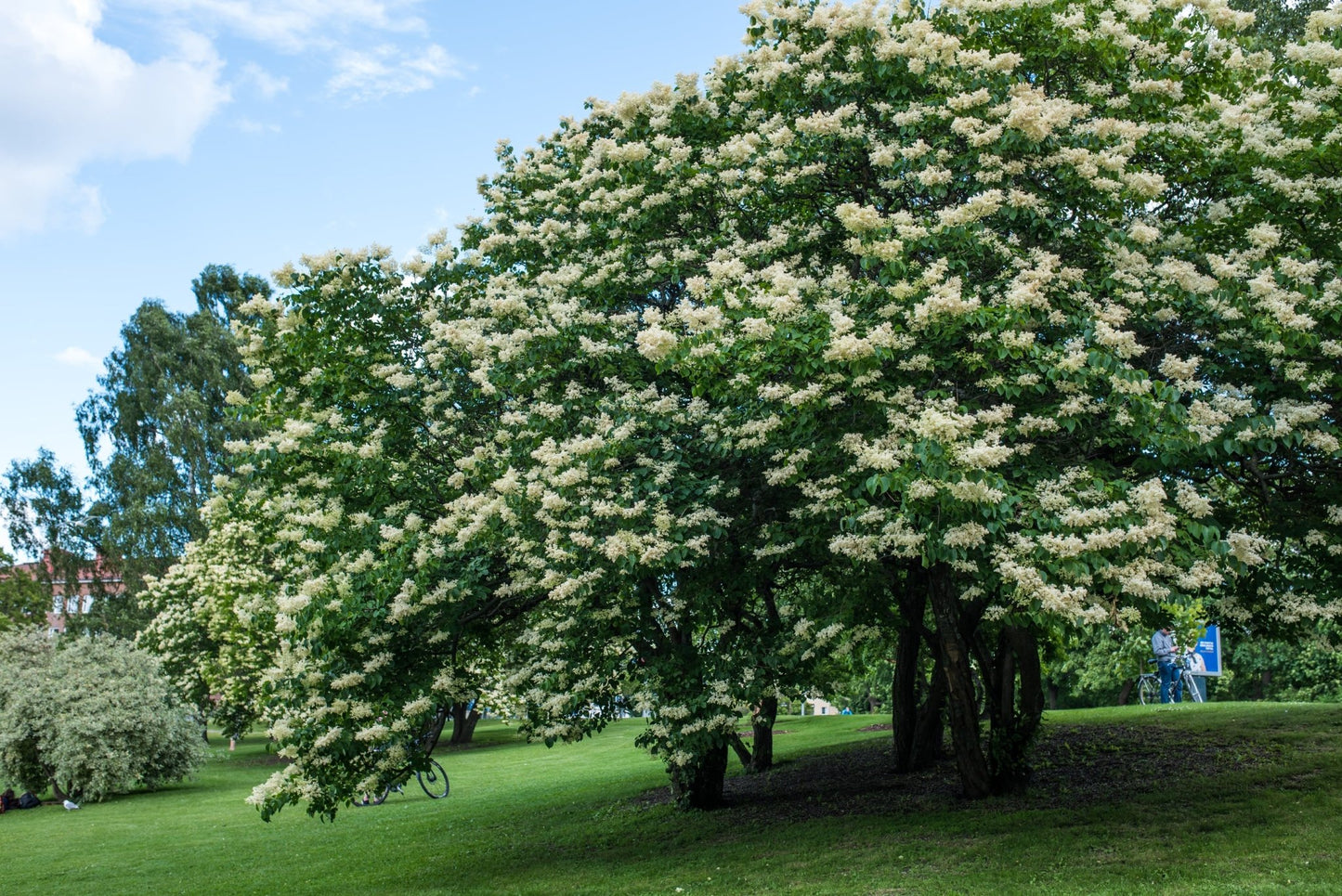


Peking Tree Lilac Seeds | Pekin Lilac | (Syringa reticulata subsp. pekinensis)
Peking Tree Lilac Seeds | Pekin Lilac | (Syringa reticulata subsp. pekinensis)
The lilac nobody knows. The one with the best bark. Better in heat than any other tree lilac.
Syringa reticulata subsp. pekinensis, the Peking Lilac or Pekin Lilac, is the Chinese subspecies of the Japanese Tree Lilac, a refined small flowering tree that deserves far wider use than it currently receives in North American horticulture. It blooms in late spring and early summer with large, creamy white flower panicles similar to the Japanese Tree Lilac but typically opening a few days earlier, and it develops the most ornamental exfoliating bark of any lilac species, peeling in thin strips to reveal rich, mahogany-red to orange-brown inner bark comparable to a birch or cherry in its winter beauty. It tolerates heat and drought better than Japanese Tree Lilac, making it a better performer in the warmer and drier parts of the Midwest and Great Plains where the Japanese form sometimes struggles. If you are looking to buy Peking Lilac seeds or grow this underused flowering tree from seed, this is the lilac that the Japanese form's admirers discover and immediately prefer for the bark alone.
- Large creamy white flower panicles in late spring and early summer with honey-sweet fragrance
- The most ornamental exfoliating bark of any lilac, peeling to reveal mahogany-red to orange-brown inner bark
- More heat-tolerant and drought-tolerant than Japanese Tree Lilac, better suited to warmer and drier climates
- Compact, graceful small tree form reaching 15 to 20 feet, fitting smaller garden spaces naturally
- Cold-hardy to zone 3, performing across the widest range of cold climates of any tree lilac
Things you probably did not know about the Peking Lilac
The bark development is among the finest of any small flowering tree in temperate horticulture. While most lilacs are grown exclusively for their flowers, Peking Lilac develops an exfoliating bark pattern over time that rivals the ornamental cherries and birches for winter interest. The outer bark peels in horizontal strips similar to cherry bark, revealing fresh mahogany-red to orange inner bark beneath that warms and deepens in color with age. The combination of fragrant summer flowers and remarkable winter bark makes Peking Lilac one of the most genuinely four-season small trees available in cold-climate horticulture.
It was introduced to western horticulture through the Peking Imperial Gardens in the late 19th century. The Peking Lilac has been cultivated in Chinese gardens for centuries, planted in temple gardens and imperial palace grounds in Beijing and surrounding regions where the tree's refinement and fragrance were appreciated in the classical Chinese garden tradition. Western botanical collectors working in northern China in the late 19th century introduced it to European and North American arboreta, where it was recognized as distinct from the Japanese Tree Lilac and valued for its superior bark character.
The fragrance is slightly different from Japanese Tree Lilac, with a warmer, more honey-like quality. Both Peking and Japanese Tree Lilac produce flowers with a distinctive privet-like sweetness different from common lilac, but the Peking subspecies is often described by fragrance enthusiasts as having a slightly warmer, more complex honey note compared to the cleaner, lighter fragrance of Japanese Tree Lilac. The difference is subtle but detectable to those who encounter both subspecies in bloom simultaneously.
Seed-grown Peking Lilacs develop individual variation in bark color intensity and flower density. Unlike clonally propagated nursery specimens selected for specific characteristics, seed-grown Peking Lilac trees develop their own individual expression of the subspecies' qualities. Some seedlings will develop the most intense mahogany-red bark while others show more orange tones. Flower cluster size and density vary between individuals. Growing from seed is the only way to produce a genuinely unique specimen rather than a copy of a named selection.
Growing Details
- Botanical Name: Syringa reticulata subsp. pekinensis
- Stratification: Required, 60 to 90 days cold stratification
- USDA Zones: 3 to 7
- Soil: Well-drained, neutral to slightly alkaline, adaptable to a range of conditions
- Light: Full sun
- Height: 15 to 20 feet
- Spread: 12 to 18 feet
- Growth Rate: Moderate, 1 to 1.5 feet per year
Plant it where the bark will be visible in winter and the flowers in June. Give it twenty years to develop the full mahogany-red exfoliating bark character and it will become the most interesting small tree on the property in the season when most gardens have nothing to show.
FAQ
FAQ
Do you pre-stratify the seeds?
Most of our seeds are not pre-stratified. They are stored under dry, cold conditions to preserve viability without initiating stratification, allowing you to time germination for your local growing season.
The exception is recalcitrant seeds. Because these seeds must remain moist to stay viable, they are kept in moist, cold storage and are therefore in a pre-stratified state. Depending on how long a particular batch has been stored, some may arrive with an emerging radicle and be ready to plant immediately. Radicle development is not guaranteed.
Please refer to the individual product page and included growing instructions for species-specific requirements.
Do any of your seeds need to stay moist? (Recalcitrant seeds)
Yes. Some species we offer, including Chestnut, Hazelnut, and Paw Paw, are recalcitrant and must remain moist to stay viable.
Please refrigerate these seeds immediately upon arrival unless they have already developed a radicle. Seeds with an emerging radicle should be planted promptly.
Do you ship internationally?
No. We currently ship within the United States only.
We previously shipped to Canada, but tariffs, duties, and import fees resulted in customers receiving significant and unpredictable additional charges upon delivery. Because we cannot reliably calculate or absorb these costs, we have suspended shipping to Canada.
At this time, we do not ship to Canada or other international destinations.
Shipping & What's Included
Shipping & What's Included
Shipping & Packaging
• Hand-packed in resealable kraft paper seed bags
• Stratification and planting instructions included on every seed pack
• Ships within 3–5 business days via USPS within the United States and U.S. territories
Return Policy
Return Policy
Due to the nature of our products, we do not accept returns on seeds.
If your order arrives damaged, contains incorrect items, or is missing items, please contact us within 7 days of delivery so we can resolve the issue.