

Paperbark Maple Tree Seeds (Acer griseum)
Paperbark Maple Tree Seeds (Acer griseum)
The most beautiful bark of any maple. The tree that reveals itself in winter.
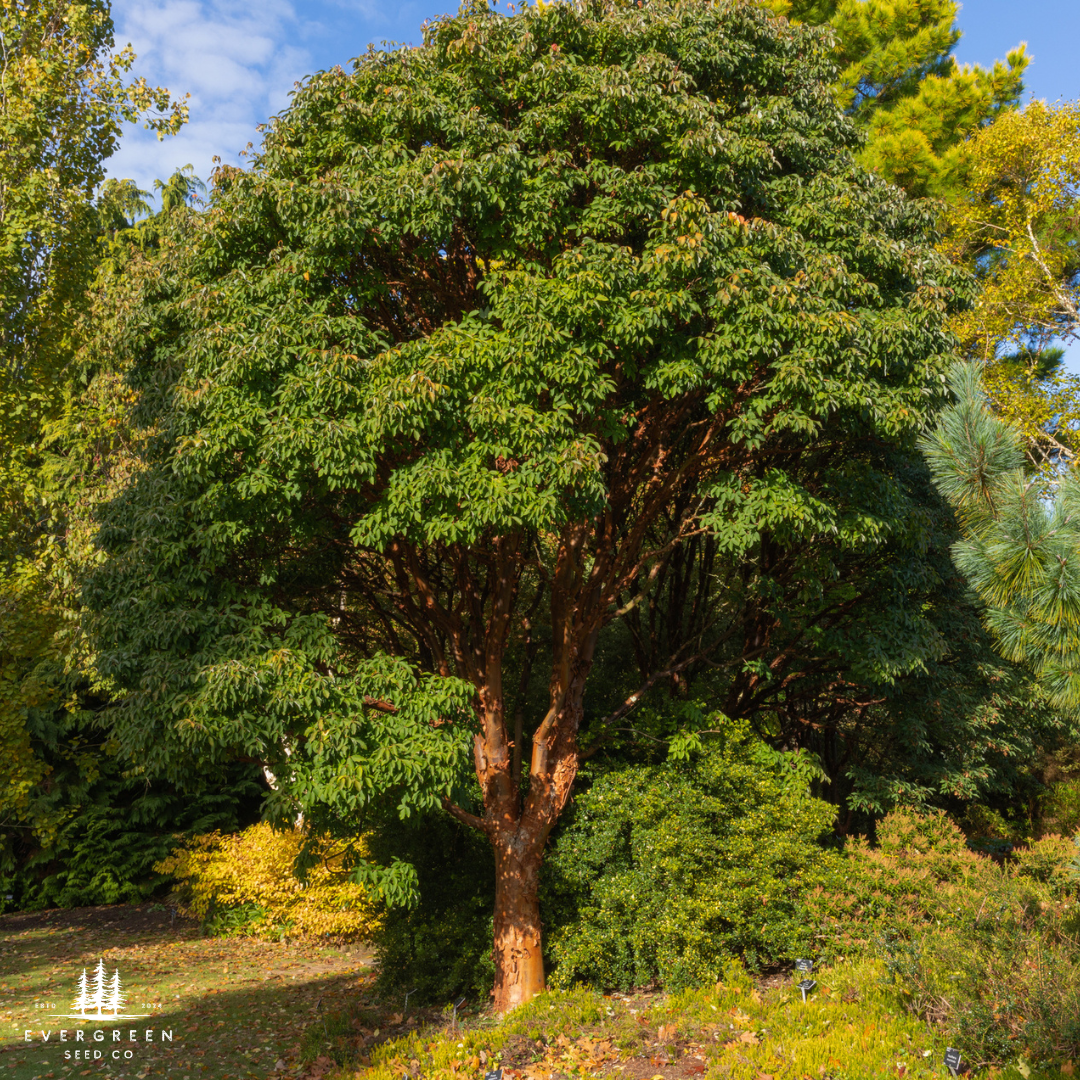
Acer griseum, the Paperbark Maple, is widely considered one of the most beautiful small trees available in temperate horticulture, celebrated primarily for its bark, which peels in thin, cinnamon-orange to reddish-brown papery layers that curl away from the trunk and branches to reveal fresh, polished wood beneath in a display that catches sunlight in a way no other maple can match. Unlike most ornamental trees whose best display is seasonal, the Paperbark Maple is arguably at its most beautiful in winter, when the bare trunk and branches glow with cinnamon and copper against snow or gray winter sky. The small, trifoliate leaves unlike any other maple turn brilliant red and orange in fall, and the overall tree remains compact enough for almost any garden situation. If you are looking to buy Paperbark Maple seeds or grow this extraordinary ornamental from seed, this is the tree that maple collectors consider the crown jewel of the genus.
- Spectacular cinnamon-orange to reddish-brown papery exfoliating bark, the most ornamental bark of any maple
- Most beautiful in winter when bare branches glow cinnamon against snow
- Small, trifoliate leaves unlike any other maple, distinctive in form through the growing season
- Brilliant red and orange fall color from small-scale but intense seasonal display
- Compact size suitable for small gardens where large maples are impractical
Things you probably did not know about the Paperbark Maple
It was introduced to western horticulture by Ernest Wilson in 1901 from Hubei Province, China. E.H. Wilson, the legendary plant hunter known as Chinese Wilson, collected Paperbark Maple seeds during his first expedition to China for the Veitch nursery in London. The tree he introduced was an immediate sensation in British horticultural circles for the bark that had never been seen on any maple previously known to western botanists. Wilson is responsible for introducing more ornamental plants to western gardens than almost any other individual in history, and the Paperbark Maple is among the finest.
It is one of the rarest maples in the wild. Paperbark Maple has an extremely restricted native range in central China and is listed as a vulnerable species in its native habitat. Wild populations are small, fragmented, and face pressure from habitat loss and collection. Cultivated populations in botanical gardens and private gardens worldwide now likely exceed the wild population. Growing Paperbark Maple from seed is a contribution to the conservation of a species that is genuinely rare in nature.
The seeds have notoriously poor germination rates from commercial sources. Paperbark Maple seeds require specific conditions to germinate and many commercial seed lots have low viability due to improper storage or collection timing. Seeds must be fresh and properly stratified to achieve reasonable germination rates. Even under optimal conditions, germination can be uneven and spread across two seasons. This difficulty is part of why Paperbark Maple is less commonly grown than its reputation warrants.
The bark color deepens and intensifies as the tree matures. Young Paperbark Maple trees show the characteristic exfoliating bark from an early age but the color and depth of the display increases significantly as the tree matures. Trees 20 to 30 years old develop the full rich cinnamon-orange that makes them so celebrated, with the peeling layers becoming thicker and more dramatically curled. The best examples of Paperbark Maple in cultivation are trees that have had decades to develop their full ornamental character.
Growing Details
- Botanical Name: Acer griseum
- Stratification: Required, 90 to 120 days cold moist stratification, germination can extend across two seasons
- USDA Zones: 4 to 8
- Soil: Well-drained, moist, slightly acidic to neutral
- Light: Full sun to partial shade
- Height: 20 to 30 feet
- Spread: 15 to 25 feet
- Growth Rate: Slow, 6 to 12 inches per year
Plant it where the trunk will be visible in January. That is when this tree earns everything. Give it two decades and it becomes the most visited tree on the property every winter morning.
FAQ
FAQ
Do you pre-stratify the seeds?
Most of our seeds are not pre-stratified. They are stored under dry, cold conditions to preserve viability without initiating stratification, allowing you to time germination for your local growing season.
The exception is recalcitrant seeds. Because these seeds must remain moist to stay viable, they are kept in moist, cold storage and are therefore in a pre-stratified state. Depending on how long a particular batch has been stored, some may arrive with an emerging radicle and be ready to plant immediately. Radicle development is not guaranteed.
Please refer to the individual product page and included growing instructions for species-specific requirements.
Do any of your seeds need to stay moist? (Recalcitrant seeds)
Yes. Some species we offer, including Chestnut, Hazelnut, and Paw Paw, are recalcitrant and must remain moist to stay viable.
Please refrigerate these seeds immediately upon arrival unless they have already developed a radicle. Seeds with an emerging radicle should be planted promptly.
Do you ship internationally?
No. We currently ship within the United States only.
We previously shipped to Canada, but tariffs, duties, and import fees resulted in customers receiving significant and unpredictable additional charges upon delivery. Because we cannot reliably calculate or absorb these costs, we have suspended shipping to Canada.
At this time, we do not ship to Canada or other international destinations.
Shipping & What's Included
Shipping & What's Included
Shipping & Packaging
• Hand-packed in resealable kraft paper seed bags
• Stratification and planting instructions included on every seed pack
• Ships within 3–5 business days via USPS within the United States and U.S. territories
Return Policy
Return Policy
Due to the nature of our products, we do not accept returns on seeds.
If your order arrives damaged, contains incorrect items, or is missing items, please contact us within 7 days of delivery so we can resolve the issue.