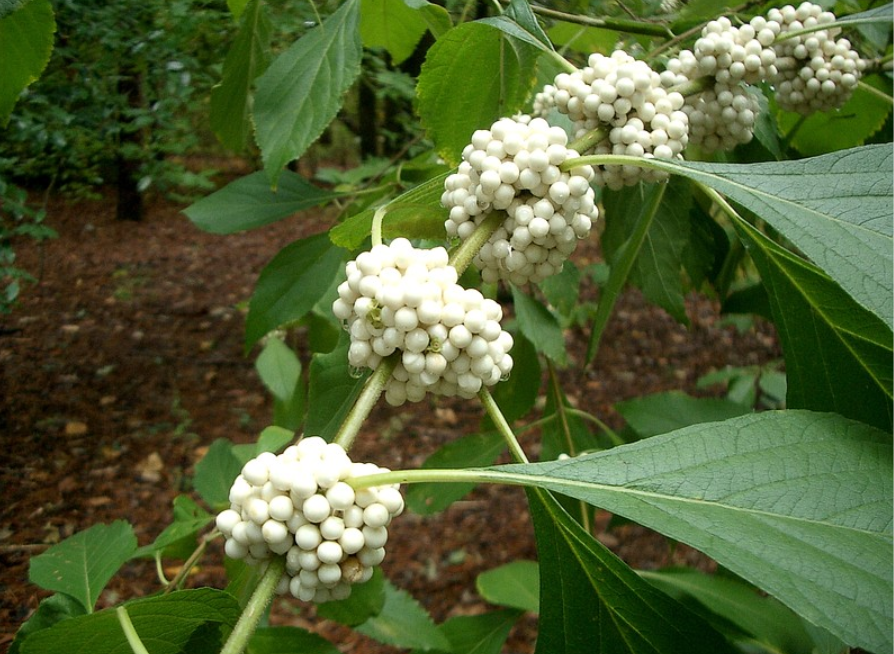


White Beautyberry Seeds | (Callicarpa japonica ‘Leucocarpa’)
White Beautyberry Seeds | (Callicarpa japonica ‘Leucocarpa’)
Every other shrub is competing for attention in autumn. This one wins by doing something no one expects.
Callicarpa japonica 'Leucocarpa', the White Beautyberry, is a refined and quietly astonishing deciduous shrub that produces clusters of pure white berries so densely packed along arching stems that the effect reads as artificial from a distance, as though someone had threaded pearl beads onto every branch by hand. A cultivar of the Japanese Beautyberry, it shares the graceful, fountain-like habit and the extraordinary berry density of the species but trades the more commonly seen purple-violet fruit for gleaming white, an unusual color in the autumn landscape that stands out with particular elegance against dark evergreens, golden foliage, and the deep tones of late-season borders. Small, pale pink flowers bloom along the stems in summer, attractive to bees and butterflies, before giving way to the persistent berry clusters that hold well into winter and provide food for birds long after most fruiting shrubs have been picked clean. The shrub is easy to grow, tolerates a range of soils and exposures, and asks for little beyond a hard annual cutback that keeps it vigorous and well-shaped. If you are looking to buy White Beautyberry seeds or grow Callicarpa japonica 'Leucocarpa' from seed, this is the rare autumn shrub that stops people in their tracks and then makes them question everything they thought they knew about seasonal color.
- Pure white berry clusters cover every stem from late summer through winter, creating one of the most unusual and striking fruiting displays in the temperate garden
- Small pale pink flowers in midsummer attract bees and butterflies before berries develop
- Graceful, arching habit with clean green foliage through the growing season and strong autumn berry interest
- Berries persist well into winter and are consumed by mockingbirds, robins, bluebirds, and other fruit-eating wildlife
- Easy to grow and responds well to hard annual pruning, which maintains vigorous fruiting and compact form
Things you probably did not know about White Beautyberry
The berry clusters of Callicarpa are technically called cymes, and their extraordinary density along the stem is the result of a very specific flowering architecture. Rather than producing fruit at the tips of branches where most shrubs concentrate their reproductive effort, Callicarpa produces flowers and subsequently berries in tight clusters that encircle the stem at each leaf node, wrapping completely around the branch at intervals along its entire length. This arrangement, called a verticillate cyme, is the reason the plant looks as though it has been decorated rather than simply fruited, and it is rare enough in temperate shrubs that it remains one of the most visually distinctive characteristics in the genus.
The white berry color in 'Leucocarpa' is caused by the absence of anthocyanin pigment, not by the presence of any white pigment compound. In the standard species, Callicarpa japonica produces its characteristic purple to violet berries through the accumulation of anthocyanins, the same class of pigments responsible for the color of blueberries, elderberries, and red cabbage. The 'Leucocarpa' cultivar carries a genetic variation that suppresses anthocyanin production entirely, resulting in berries that are pure white because no colored pigment is deposited. This type of color variant, known as an albescent form, occurs naturally in several berry-producing plants and has been selected and propagated in Callicarpa for its ornamental novelty.
Callicarpa species have a long history of use in traditional East Asian medicine, particularly for wound treatment and inflammation. The leaves and roots of various Callicarpa species have been used in Chinese, Japanese, and Korean folk medicine for centuries to treat bleeding wounds, skin infections, and inflammatory conditions. Modern pharmacological research has identified several classes of bioactive compounds in the genus including callicarpenal, a terpenoid compound with demonstrated insect-repellent properties, and various flavonoids with anti-inflammatory activity. Research into Callicarpa as a source of natural insect repellent compounds has produced results significant enough to attract interest from agricultural and pharmaceutical researchers.
Seed-grown plants of Callicarpa japonica will not reliably come true to the white-berried form. The 'Leucocarpa' cultivar is a selected form that must be propagated vegetatively through cuttings to guarantee white fruit. Seeds produced by white-berried plants, particularly when pollinated by nearby purple-fruited forms, will yield seedlings that predominantly revert toward purple or intermediate berry colors reflecting the dominant anthocyanin-producing genetics of the species. This makes seed-grown plants an exploration rather than a guarantee, ideal for growers interested in observing natural variation and potentially discovering new color forms, but not appropriate when a specific berry color is the primary goal.
Growing Details
- Botanical Name: Callicarpa japonica 'Leucocarpa'
- Seed Treatment: Light cold stratification of 30 to 60 days at 34 to 40 degrees Fahrenheit in moist medium can improve germination; surface sow or cover lightly after stratification
- USDA Zones: 5 to 8
- Soil: Adaptable to a range of well-drained soils; prefers moderately fertile, evenly moist loam but tolerates clay and periods of drought once established
- Light: Full sun to partial shade; best berry production and most compact habit in full sun
- Height: 4 to 6 feet
- Spread: 4 to 6 feet
- Growth Rate: Moderate to fast; cut back hard in late winter to encourage vigorous new growth and heavy fruiting on current-season wood
Plant it where autumn light catches the stems from behind, ideally against a dark backdrop of evergreens or a fence. The white berries appear in late summer and seem to intensify as the season progresses, and by the time the leaves have dropped and the bare, bead-strung stems stand alone against the late autumn garden, you will understand why this shrub earns a permanent place in any serious planting.
FAQ
FAQ
Do you pre-stratify the seeds?
Most of our seeds are not pre-stratified. We ship them unstratified so you can control germination timing based on your local growing season. We sell to all 50 U.S. states and Canadian provinces, and since each region has different planting windows, pre-stratifying would risk seeds germinating in transit or before you're ready to plant.
True stratification requires cold, moist conditions, which can lead to premature sprouting or mold if not timed properly. To avoid this, we store most seeds in dry cold conditions to preserve viability — but this does not initiate stratification.
Do any of your seeds need to stay moist? (Recalcitrant seeds)
Yes — some species we offer are recalcitrant, meaning they must remain moist to stay viable and cannot be dried out. Examples include: Chestnut, Hazelnut, Paw Paw, etc.
These seeds are shipped in moist cold storage and are clearly labeled on the product page when applicable. Please refrigerate immediately upon arrival and follow included care instructions.
Do you ship internationally?
We currently ship to the United States and Canada only. Unfortunately, we cannot ship to other countries without a phytosanitary certificate, which is required by most international customs agencies.
If you're interested in shipping outside North America, please contact us. Note that a phytosanitary certificate typically adds $60–$80 USD per seed type and must be arranged in advance.
Shipping & What's Included
Shipping & What's Included
Shipping & Packaging
Hand-packed in resealable zipper kraft paper seed bags
Stratification and planting instructions included with every order
1 free bonus seed pack included with every order
Ships within 3–5 business days via USPS
Return Policy
Return Policy
Due to the nature of our products, we do not accept returns on seeds.
However, if your order arrives damaged or incorrect, please contact us within 7 days and we’ll make it right.