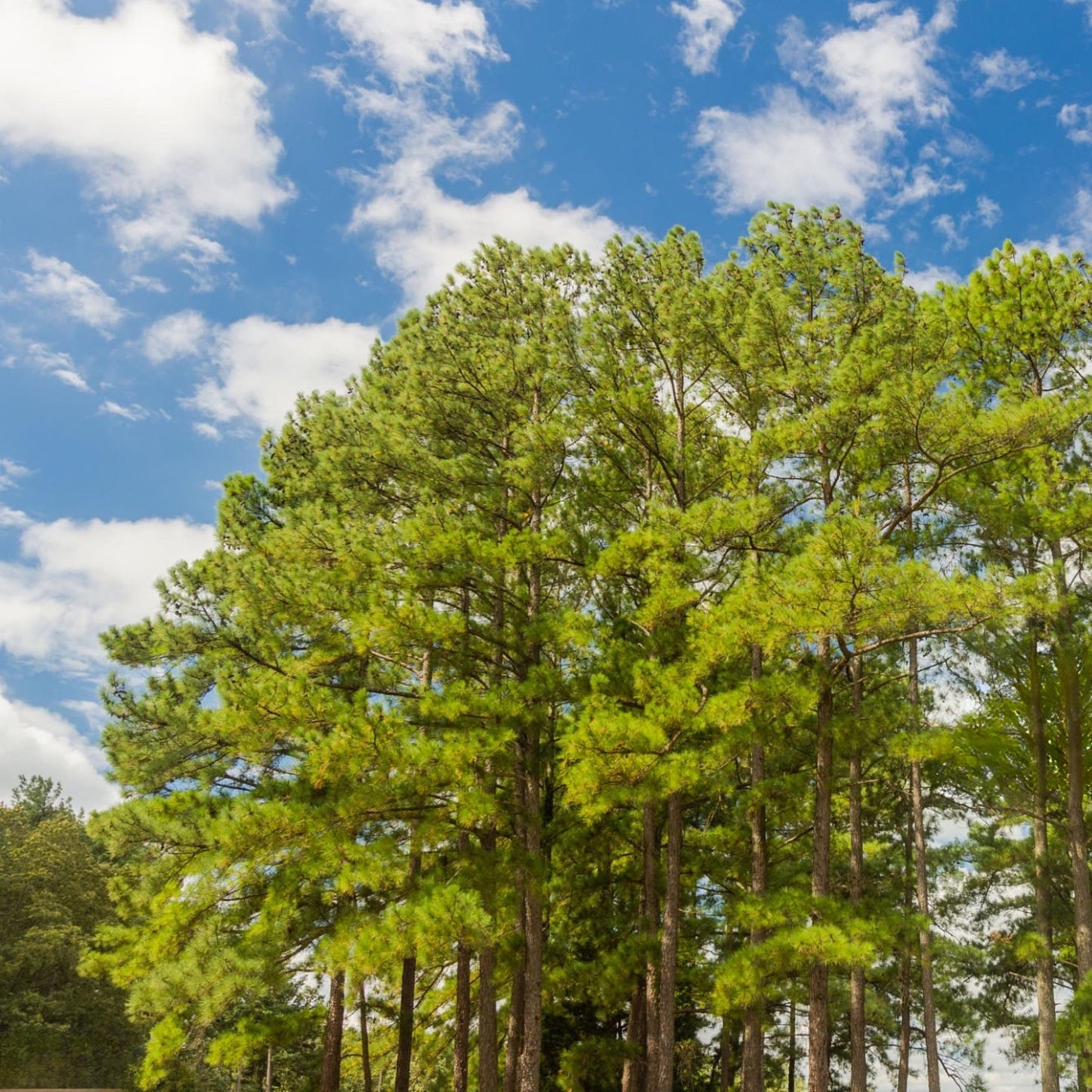


Improved Loblolly Pine Tree Seeds | Oldfield Pine | (Pinus taeda)
Improved Loblolly Pine Tree Seeds | Oldfield Pine | (Pinus taeda)
The most important timber pine in the South. Growing from your hands.
Pinus taeda, the Loblolly Pine, is the most commercially important timber tree in the eastern United States and the second most planted tree in the world after the coconut palm. It covers more acres of southeastern forest than any other single tree species and produces more timber volume than any other American pine. Fast-growing, adaptable, and highly productive, it is the backbone of the southern timber industry and increasingly important for pulpwood, biomass, and carbon sequestration programs. Improved seed selections have been developed for increased growth rate, straightness, and disease resistance, producing trees that outperform wild populations by measurable margins. If you are looking to buy Loblolly Pine seeds or grow southern yellow pine from seed, this is the tree that the southern forest economy is built on.
- The most commercially important timber tree in the eastern United States
- The second most planted tree in the world by volume, behind only the coconut palm
- Improved seed selections offer enhanced growth rate, straightness, and disease resistance over wild stock
- Extremely fast-growing, one of the fastest large pine species in North American horticulture
- Adaptable to a wide range of soils across the southeastern United States
Things you probably did not know about the Loblolly Pine
It grows over 60 million acres in the southeastern United States alone. Loblolly Pine is the dominant commercial species across the entire southern timber belt from Virginia to Texas and from the coastal plain to the piedmont. The total standing volume of Loblolly Pine in the US exceeds that of any other tree species in the country.
The name means muddy hole in old Southern dialect. Loblolly was a term used in the colonial-era South for a low, muddy depression, exactly the kind of wet, poorly drained site where the tree grows naturally. The common name stuck even though the tree grows equally well on well-drained upland sites.
It sequesters carbon faster than almost any other temperate tree. The combination of fast growth and large final size makes Loblolly Pine one of the most effective carbon sequestration trees available in the eastern United States. Forestry carbon credit programs have enrolled millions of acres of Loblolly Pine plantations specifically because of the speed at which the trees accumulate biomass.
Improved seed orchards have transformed southern forestry productivity. Since the 1950s, cooperative tree improvement programs at southern universities have selected, bred, and tested superior Loblolly Pine genotypes for commercial planting. The improved selections available today grow 15 to 25 percent faster than unselected wild stock and show significantly better form and disease resistance, representing decades of scientific plant breeding.
Growing Details
- Botanical Name: Pinus taeda
- Stratification: Recommended, 30 to 60 days cold stratification
- USDA Zones: 6 to 9
- Soil: Adaptable, tolerates poor, sandy, clay, or wet soils across a wide range
- Light: Full sun
- Height: 60 to 100 feet
- Spread: 20 to 35 feet
- Growth Rate: Very fast, 3 to 5 feet per year in ideal conditions
Plant it in the Southeast where it belongs and let it do what it has been doing for millions of years. No pine in the South grows faster.
FAQ
FAQ
Do you pre-stratify the seeds?
Most of our seeds are not pre-stratified. They are stored under dry, cold conditions to preserve viability without initiating stratification, allowing you to time germination for your local growing season.
The exception is recalcitrant seeds. Because these seeds must remain moist to stay viable, they are kept in moist, cold storage and are therefore in a pre-stratified state. Depending on how long a particular batch has been stored, some may arrive with an emerging radicle and be ready to plant immediately. Radicle development is not guaranteed.
Please refer to the individual product page and included growing instructions for species-specific requirements.
Do any of your seeds need to stay moist? (Recalcitrant seeds)
Yes. Some species we offer, including Chestnut, Hazelnut, and Paw Paw, are recalcitrant and must remain moist to stay viable.
Please refrigerate these seeds immediately upon arrival unless they have already developed a radicle. Seeds with an emerging radicle should be planted promptly.
Do you ship internationally?
No. We currently ship within the United States only.
We previously shipped to Canada, but tariffs, duties, and import fees resulted in customers receiving significant and unpredictable additional charges upon delivery. Because we cannot reliably calculate or absorb these costs, we have suspended shipping to Canada.
At this time, we do not ship to Canada or other international destinations.
Shipping & What's Included
Shipping & What's Included
Shipping & Packaging
• Hand-packed in resealable kraft paper seed bags
• Stratification and planting instructions included on every seed pack
• Ships within 3–5 business days via USPS within the United States and U.S. territories
Return Policy
Return Policy
Due to the nature of our products, we do not accept returns on seeds.
If your order arrives damaged, contains incorrect items, or is missing items, please contact us within 7 days of delivery so we can resolve the issue.