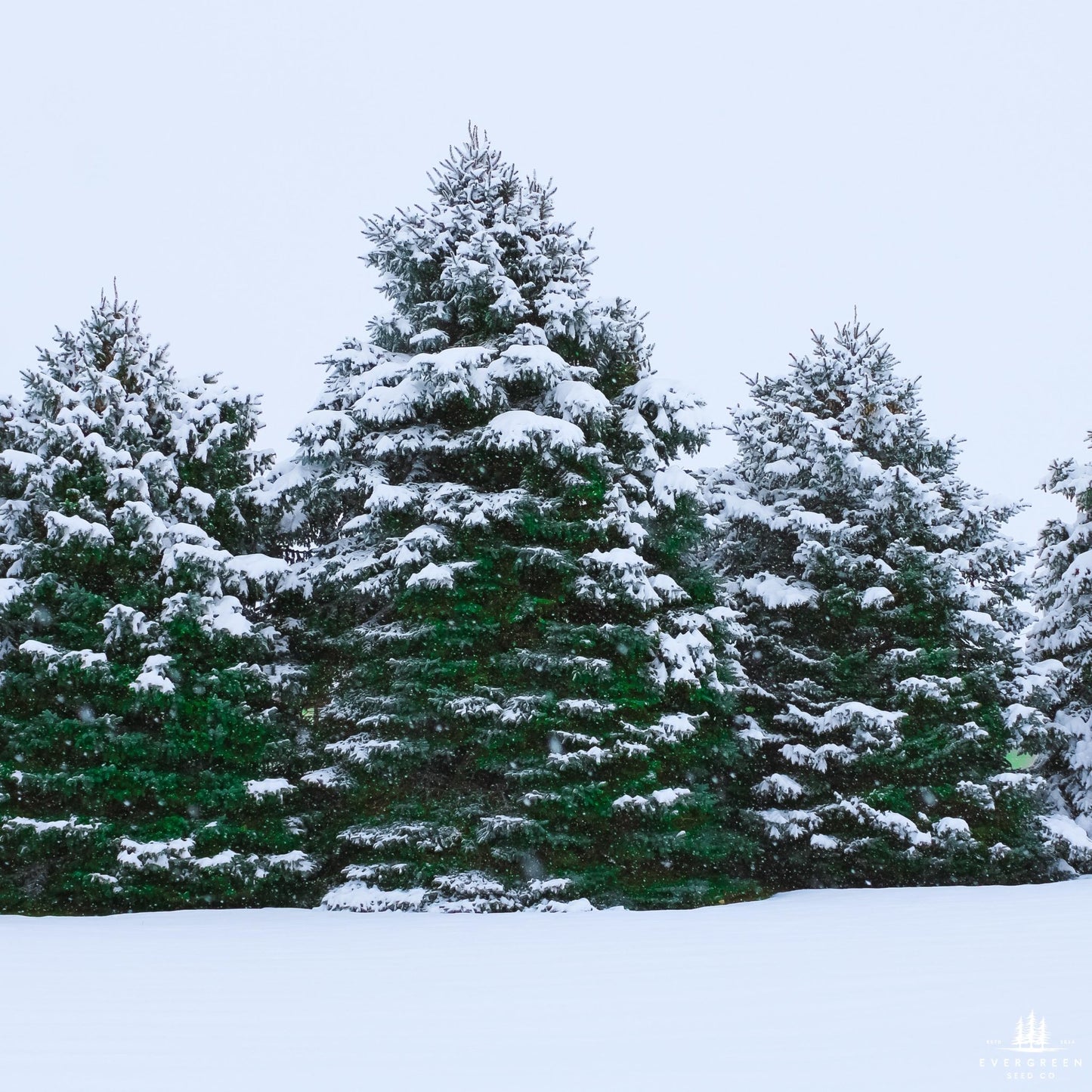


Douglas Fir Tree Seeds | Oregon Pine | (Pseudotsuga menziesii)
Douglas Fir Tree Seeds | Oregon Pine | (Pseudotsuga menziesii)
The backbone of the western forest. The most harvested timber tree in North America.
Pseudotsuga menziesii, the Douglas Fir, is not actually a true fir. It is unique enough that it has its own genus, Pseudotsuga, which means false hemlock. It is the most important timber tree in North America, the dominant species of the Pacific Northwest old-growth forest, and one of the most massive trees on Earth, with documented specimens exceeding 300 feet in height. It also grows faster than most other large conifers, adapts to a wide range of conditions across the continent, and produces seeds that germinate readily with basic cold stratification. If you are looking to buy Douglas Fir seeds or grow this iconic western conifer from seed, you are starting what could become one of the largest trees on your property within a human lifetime.
- The most important commercial timber tree in North America, dominant in Pacific Northwest forests
- One of the tallest tree species in the world, with wild specimens documented over 300 feet
- Produces a striking cone with distinctive three-pronged bracts found on no other conifer
- Adaptable across a wide range of sites from coastal Washington to the Rocky Mountains
- Fast-growing for a large conifer, establishing quickly and building significant height within decades
Things you probably did not know about the Douglas Fir
The cones are botanically unique in the entire plant kingdom.
The distinctive three-pronged bracts that protrude from between the scales of a Douglas Fir cone exist in no other plant. There is a folk legend about mice seeking shelter inside the cone during a forest fire, with their hind legs and tails sticking out between the scales. The botanical Latin name for the bracts acknowledges this story in its etymology.
It is the most harvested tree in North American history.
More board feet of Douglas Fir have been cut in North America than any other single species. The combination of its extraordinary size, fast growth, high strength-to-weight ratio, and widespread distribution made it the defining timber of 20th century western construction. The great majority of wooden framed buildings in the western United States are built primarily from Douglas Fir lumber.
Old growth Douglas Firs can exceed 1,000 years old.
Some of the surviving old-growth Douglas Firs in the Pacific Northwest are documented at 700 to 1,200 years old. Trees of this age have trunks 10 feet or more in diameter and support entire ecosystems in their canopies, including plants, birds, and mammals that require old-growth conditions to survive.
The seeds are designed to spin.
Like many conifers, Douglas Fir seeds are attached to a single wing that causes them to spiral as they fall, slowing their descent and allowing them to travel hundreds of feet from the parent tree on a windy day. A single mature Douglas Fir can produce millions of seeds in a good mast year.
Growing Details
- Botanical Name: Pseudotsuga menziesii
- Stratification: Required, 30 to 60 days cold stratification
- USDA Zones: 4 to 6 for coastal variety, 3 to 6 for Rocky Mountain variety
- Soil: Well-drained, moist, slightly acidic, adaptable to a range of soils
- Light: Full sun
- Height: 80 to 200 feet
- Spread: 15 to 30 feet
- Growth Rate: Fast, 2 to 3 feet per year when young
Plant it where you have room for something that will eventually be the largest thing in the landscape. This is not a tree for small spaces. It is a tree for big ambitions.
FAQ
FAQ
Do you pre-stratify the seeds?
Most of our seeds are not pre-stratified. They are stored under dry, cold conditions to preserve viability without initiating stratification, allowing you to time germination for your local growing season.
The exception is recalcitrant seeds. Because these seeds must remain moist to stay viable, they are kept in moist, cold storage and are therefore in a pre-stratified state. Depending on how long a particular batch has been stored, some may arrive with an emerging radicle and be ready to plant immediately. Radicle development is not guaranteed.
Please refer to the individual product page and included growing instructions for species-specific requirements.
Do any of your seeds need to stay moist? (Recalcitrant seeds)
Yes. Some species we offer, including Chestnut, Hazelnut, and Paw Paw, are recalcitrant and must remain moist to stay viable.
Please refrigerate these seeds immediately upon arrival unless they have already developed a radicle. Seeds with an emerging radicle should be planted promptly.
Do you ship internationally?
No. We currently ship within the United States only.
We previously shipped to Canada, but tariffs, duties, and import fees resulted in customers receiving significant and unpredictable additional charges upon delivery. Because we cannot reliably calculate or absorb these costs, we have suspended shipping to Canada.
At this time, we do not ship to Canada or other international destinations.
Shipping & What's Included
Shipping & What's Included
Shipping & Packaging
• Hand-packed in resealable kraft paper seed bags
• Stratification and planting instructions included on every seed pack
• Ships within 3–5 business days via USPS within the United States and U.S. territories
Return Policy
Return Policy
Due to the nature of our products, we do not accept returns on seeds.
If your order arrives damaged, contains incorrect items, or is missing items, please contact us within 7 days of delivery so we can resolve the issue.