

Cornelian Cherry Tree Seeds | Cornelian Cherry Dogwood | (Cornus mas)
Cornelian Cherry Tree Seeds | Cornelian Cherry Dogwood | (Cornus mas)
The dogwood that feeds you. The first flower of spring. The medicine chest of ancient Europe.
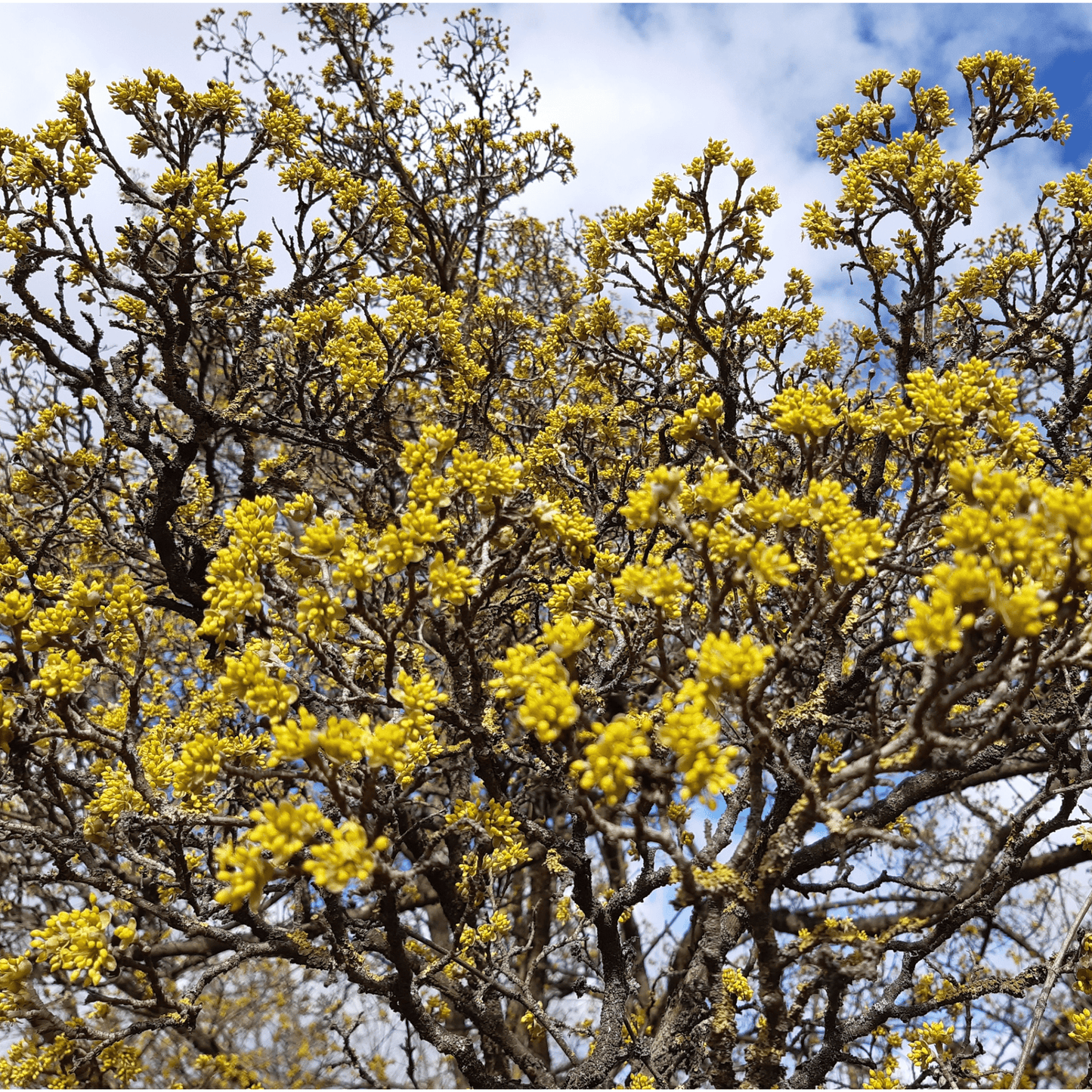
Cornus mas, the Cornelian Cherry, is not actually a cherry at all but a dogwood, a deciduous shrub or small tree native to southern Europe and western Asia that produces masses of tiny yellow flowers on bare stems in late winter before almost anything else in the temperate garden has stirred, followed in late summer by brilliant red, cherry-like fruits that are tart, richly flavored, and one of the oldest cultivated fruits in European history. It is one of the earliest-flowering woody plants of the season, blooming weeks before forsythia and months before most other spring flowers, and the red fruits it produces in August are eaten fresh, dried, made into jam and juice, and fermented into wine and spirits across Eastern Europe, Turkey, and the Caucasus where cultivation has continued uninterrupted for over 7,000 years. If you are looking to buy Cornelian Cherry seeds or grow this ancient fruit shrub from seed, you are planting one of the most historically significant edible plants in the Old World.
- Masses of tiny yellow flowers covering bare branches in late winter, among the earliest-flowering woody plants of the season
- Brilliant red tart fruits ripening in late summer, edible fresh and excellent in preserves, juice, and wine
- One of the oldest cultivated fruits in European and Middle Eastern history, grown continuously for over 7,000 years
- Extremely cold-hardy, tolerating zone 4 winters with no damage
- Attractive exfoliating bark and reliable fall color, ornamental across all four seasons
Things you probably did not know about the Cornelian Cherry
The fruits have been found at archaeological sites dating back 7,500 years. Cornelian Cherry fruits have been recovered from Bronze Age and Neolithic archaeological sites across southeastern Europe, Turkey, and the Caucasus, making it one of the most ancient fruits in the human record. The fruits were consumed by humans living in the region that became the cradle of western civilization, eaten by the same people who developed the first writing systems and founded the first cities.
It was a medicinal staple throughout ancient Greece and Rome. Cornelian Cherry was used across the ancient Mediterranean world as a treatment for diarrhea and digestive complaints, as a fever remedy, and as a general tonic. The high tannin content of the fruit and bark provides genuine astringent properties that explain its effectiveness for the digestive conditions it was most commonly used to treat. Both Hippocrates and Pliny the Elder described its medicinal applications.
The wood is the hardest of any European tree. Cornelian Cherry wood has a Janka hardness exceeding most European hardwoods including oak, ash, and hornbeam. It was the preferred material for spear shafts, arrow shafts, and tool handles throughout ancient Greece and Rome because it combined extreme hardness with a fine, straight grain that resisted splitting under impact. The Trojan Horse in Homer's Iliad is described as built from fir and Cornelian Cherry wood.
The flowers open before any insects are ready to pollinate them. Cornelian Cherry flowers in late January and February in mild years, often during periods when temperatures are still below freezing and almost no pollinating insects are active. It is primarily pollinated by the few early-emerging bees that are active on warm winter days, making it an important plant for queen bumblebees completing their winter emergence. The extremely early bloom means most fruits set on a very small percentage of the flowers.
Growing Details
- Botanical Name: Cornus mas
- Stratification: Required, warm stratification of 90 to 120 days followed by 60 to 90 days cold stratification
- USDA Zones: 4 to 8
- Soil: Adaptable, tolerates alkaline, dry, or clay soils, prefers well-drained, slightly alkaline to neutral conditions
- Light: Full sun to partial shade
- Height: 15 to 25 feet
- Spread: 15 to 20 feet
- Growth Rate: Slow to moderate, 1 to 1.5 feet per year
Plant it where you will see it from a window in February. When everything else is dormant and gray and the Cornelian Cherry opens its yellow flowers on bare stems in the first warm spell of late winter, the season changes. That is the whole point.
FAQ
FAQ
Do you pre-stratify the seeds?
Most of our seeds are not pre-stratified. They are stored under dry, cold conditions to preserve viability without initiating stratification, allowing you to time germination for your local growing season.
The exception is recalcitrant seeds. Because these seeds must remain moist to stay viable, they are kept in moist, cold storage and are therefore in a pre-stratified state. Depending on how long a particular batch has been stored, some may arrive with an emerging radicle and be ready to plant immediately. Radicle development is not guaranteed.
Please refer to the individual product page and included growing instructions for species-specific requirements.
Do any of your seeds need to stay moist? (Recalcitrant seeds)
Yes. Some species we offer, including Chestnut, Hazelnut, and Paw Paw, are recalcitrant and must remain moist to stay viable.
Please refrigerate these seeds immediately upon arrival unless they have already developed a radicle. Seeds with an emerging radicle should be planted promptly.
Do you ship internationally?
No. We currently ship within the United States only.
We previously shipped to Canada, but tariffs, duties, and import fees resulted in customers receiving significant and unpredictable additional charges upon delivery. Because we cannot reliably calculate or absorb these costs, we have suspended shipping to Canada.
At this time, we do not ship to Canada or other international destinations.
Shipping & What's Included
Shipping & What's Included
Shipping & Packaging
• Hand-packed in resealable kraft paper seed bags
• Stratification and planting instructions included on every seed pack
• Ships within 3–5 business days via USPS within the United States and U.S. territories
Return Policy
Return Policy
Due to the nature of our products, we do not accept returns on seeds.
If your order arrives damaged, contains incorrect items, or is missing items, please contact us within 7 days of delivery so we can resolve the issue.