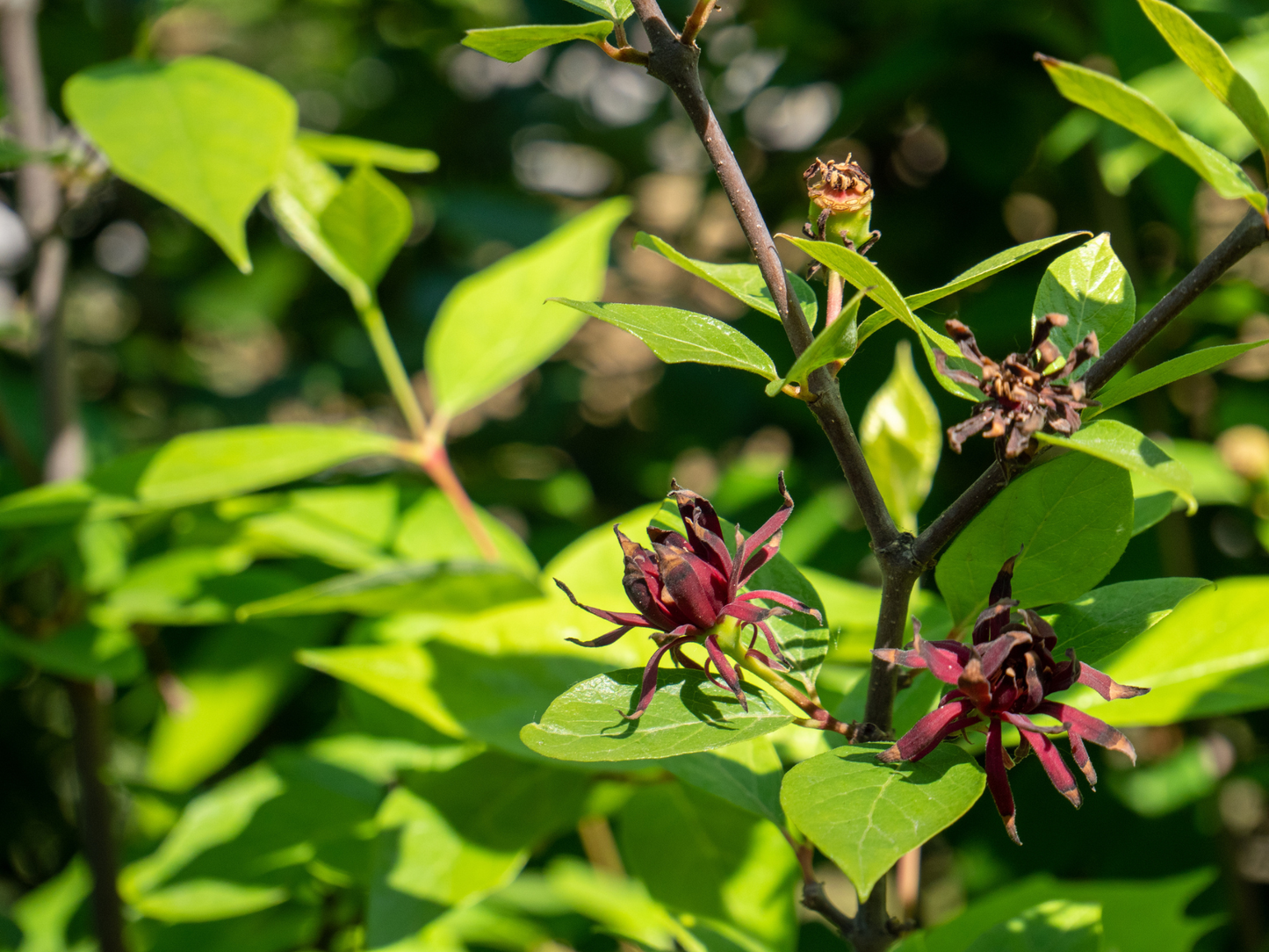


Carolina Allspice Seeds | Carolina Sweetshrub | (Calycanthus floridus)
Carolina Allspice Seeds | Carolina Sweetshrub | (Calycanthus floridus)
Burgundy flowers that smell like strawberries and spice. The native shrub that surprises everyone.
Calycanthus floridus, the Carolina Allspice or Carolina Sweetshrub, produces one of the most unusual and fragrant flowers of any native shrub in eastern North America, deep burgundy-red to maroon blooms with strap-like petals arranged in a swirled pattern that emerges from the leaf axils in late spring and early summer and releases a complex, intensely sweet fragrance combining strawberry, spice, and banana that stops people in their tracks and causes them to look around in confusion before they trace the scent to its source. The flower fragrance is so distinctive and so pleasant that the shrub has been grown in American gardens since colonial times, appearing in virtually every documented historic garden from the 18th century onward. It grows in full sun or partial shade, tolerates a wide range of soils, and develops into a dense, rounded shrub with large, aromatic dark green leaves that release a spicy fragrance when crushed. If you are looking to buy Carolina Allspice seeds or grow this native sweetshrub from seed, this is the shrub whose fragrance alone justifies growing it.
- Deep burgundy-red flowers with strap-like petals releasing an intense strawberry-spice fragrance in late spring
- The fragrance is complex and powerful, often described as the best flower fragrance of any eastern native shrub
- Native to the southeastern United States, adaptable to full sun and partial shade across a wide range of soils
- Aromatic foliage releasing a spicy scent when crushed, providing additional fragrance interest through the season
- Dense, rounded form providing good garden structure with attractive large dark green leaves through summer
Things you probably did not know about the Carolina Allspice
The flower fragrance comes from a different volatile compound mixture than any other fragrant native shrub. The distinctive scent of Carolina Allspice flowers is produced by a combination of volatile compounds including cinnamaldehyde, eugenol, and various esters that create the spicy, fruity, complex fragrance impossible to categorize as simply floral or fruity or spicy. The scent has been compared to strawberries, red wine, cantaloupe, pineapple, and cloves simultaneously by different people experiencing it for the first time, reflecting the genuinely complex mixture of aromatic compounds that produce it.
Thomas Jefferson grew it at Monticello and considered it one of the finest native shrubs. Jefferson's garden notes at Monticello document Carolina Allspice planted in prominent positions in the ornamental garden, reflecting its status as one of the most valued native ornamental shrubs among educated American gardeners of the 18th century. Jefferson, who was deeply interested in documenting the ornamental potential of American native plants, placed Carolina Allspice alongside Eastern Redbud and other natives that he believed deserved wider cultivation in American and European gardens.
The flowers have a unique structure that temporarily traps small beetles as pollinators. Carolina Allspice flowers are pollinated primarily by small beetles that are temporarily trapped inside the flower chamber by inward-pointing hairs that prevent escape until the flower has released its pollen onto the beetle. Once the pollen is deposited, the hairs relax and the beetle escapes, carrying pollen to the next flower it visits. This beetle trap pollination mechanism is primitive and ancient, shared with magnolias and a small number of other plant families that evolved before bees became the dominant pollinators.
The fragrance intensity varies dramatically between individual seed-grown plants. Carolina Allspice fragrance is genetically variable, with some individuals producing an almost overwhelming spicy-sweet scent and others producing little to no detectable fragrance. This variation is well-documented and is the reason that serious buyers of Carolina Allspice are always advised to smell the plant before purchasing rather than selecting by appearance alone. Seed-grown plants express the full range of this fragrance variability, making seed growing a genuine discovery process.
Growing Details
- Botanical Name: Calycanthus floridus
- Stratification: Required, 60 to 90 days cold moist stratification
- USDA Zones: 4 to 9
- Soil: Adaptable, prefers moist, rich, slightly acidic soil but tolerates a range of conditions
- Light: Full sun to full shade
- Height: 6 to 12 feet
- Spread: 6 to 12 feet
- Growth Rate: Moderate, 1 to 2 feet per year
Plant it near a path, entrance, or seating area where the fragrance will be encountered regularly. When you find the individual with the most intense fragrance in a seed-grown batch you will know exactly which one to propagate and keep as a permanent garden resident.
FAQ
FAQ
Do you pre-stratify the seeds?
Most of our seeds are not pre-stratified. They are stored under dry, cold conditions to preserve viability without initiating stratification, allowing you to time germination for your local growing season.
The exception is recalcitrant seeds. Because these seeds must remain moist to stay viable, they are kept in moist, cold storage and are therefore in a pre-stratified state. Depending on how long a particular batch has been stored, some may arrive with an emerging radicle and be ready to plant immediately. Radicle development is not guaranteed.
Please refer to the individual product page and included growing instructions for species-specific requirements.
Do any of your seeds need to stay moist? (Recalcitrant seeds)
Yes. Some species we offer, including Chestnut, Hazelnut, and Paw Paw, are recalcitrant and must remain moist to stay viable.
Please refrigerate these seeds immediately upon arrival unless they have already developed a radicle. Seeds with an emerging radicle should be planted promptly.
Do you ship internationally?
No. We currently ship within the United States only.
We previously shipped to Canada, but tariffs, duties, and import fees resulted in customers receiving significant and unpredictable additional charges upon delivery. Because we cannot reliably calculate or absorb these costs, we have suspended shipping to Canada.
At this time, we do not ship to Canada or other international destinations.
Shipping & What's Included
Shipping & What's Included
Shipping & Packaging
• Hand-packed in resealable kraft paper seed bags
• Stratification and planting instructions included on every seed pack
• Ships within 3–5 business days via USPS within the United States and U.S. territories
Return Policy
Return Policy
Due to the nature of our products, we do not accept returns on seeds.
If your order arrives damaged, contains incorrect items, or is missing items, please contact us within 7 days of delivery so we can resolve the issue.