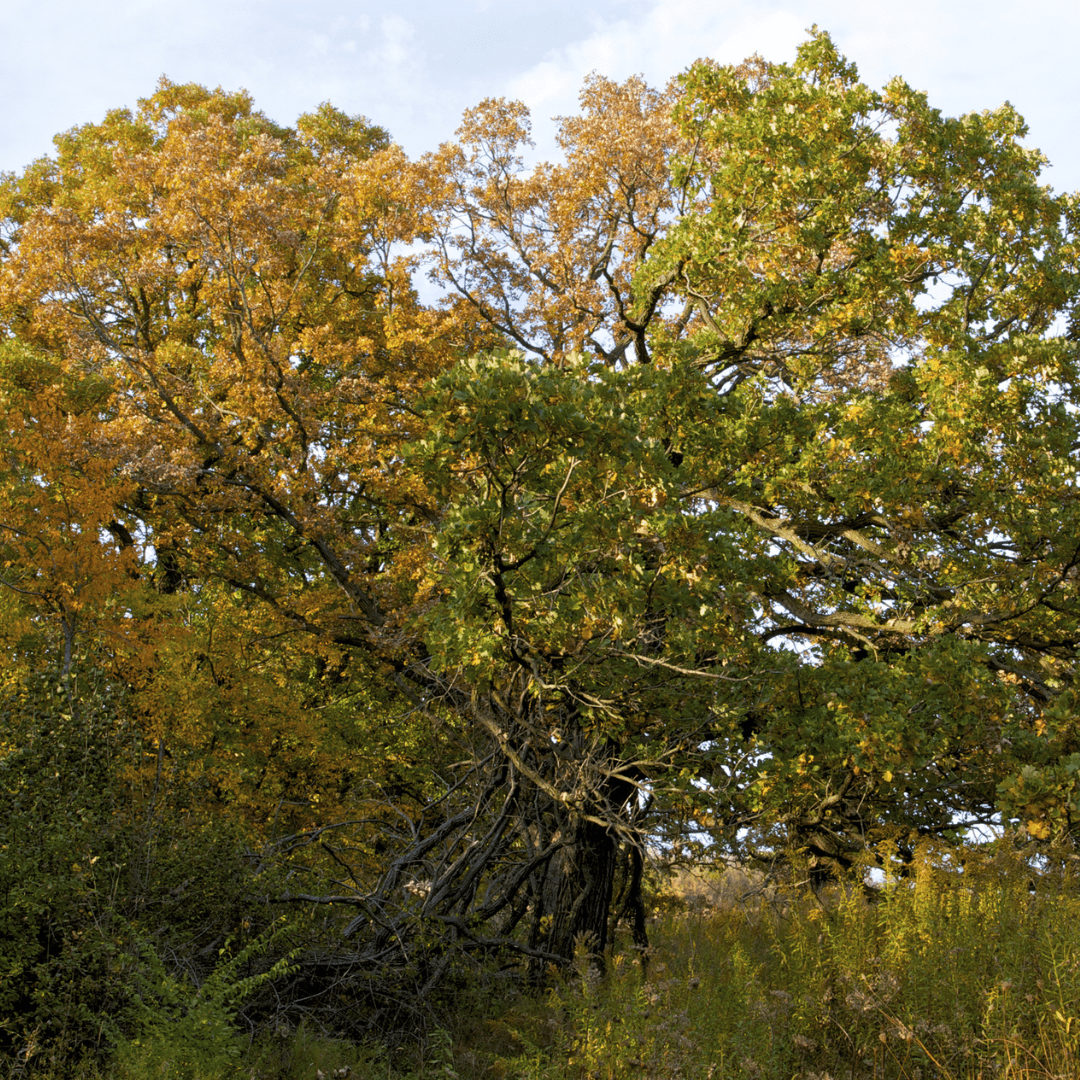


Bur Oak Tree Seeds (Quercus macrocarpa)
Bur Oak Tree Seeds (Quercus macrocarpa)
The toughest oak in North America. Built for fire, drought, and centuries.
Quercus macrocarpa, the Bur Oak, is the most drought-tolerant, fire-resistant, and cold-hardy of all native oaks, the species that pushed furthest out onto the Great Plains ahead of every other forest tree and held its ground against the grassland fires, extreme winters, and summer droughts that define that landscape. Its bark is so thick it can survive fires that kill every other tree in a community. Its taproot drills so deep into the subsoil that it persists through droughts that desiccate the surface. Its acorns, the largest of any eastern oak with their distinctive fringed caps, are consumed by deer, turkey, bear, squirrel, wood ducks, and dozens of other species. If you are looking to buy Bur Oak seeds or grow this iconic prairie oak from seed, this is the tree that survived everything the continent could throw at it and came out stronger for it.
- The most fire-resistant and drought-tolerant native oak in North America
- Produces the largest acorns of any eastern oak, with distinctive fringed caps covering half the nut
- Extremely long-lived, with documented specimens regularly exceeding 400 years
- Cold-hardy to zone 2, the northernmost naturally occurring oak species in North America
- Deep taproot system allowing it to survive drought conditions that kill other oaks
Things you probably did not know about the Bur Oak
The bark can be 4 inches thick on old trees. The deeply furrowed, corky bark of a mature Bur Oak is among the thickest of any North American hardwood. This bark insulates the living cambium from ground fires so effectively that Bur Oaks on the forest-prairie border survived the periodic grassland fires that swept the Great Plains for thousands of years, while other species were repeatedly killed back and regenerated from roots. The Bur Oak did not regenerate. It simply did not burn.
It was the landmark tree of the American frontier. Early surveyors and settlers moving onto the Great Plains used isolated Bur Oaks as landmarks and meeting points because they were the most visible trees in an otherwise treeless landscape. The practice of recording Bur Oaks in survey notes as corners and reference points for land grants is documented throughout the public land survey records of the Midwest from the 18th and 19th centuries.
The acorns are low in tannins and were eaten by Indigenous peoples. Unlike most oak acorns that require extensive leaching to remove bitter tannins before they are edible, Bur Oak acorns have relatively low tannin content and were eaten raw or with minimal processing by Indigenous peoples across the Great Plains and Midwest. They were also ground into a meal and mixed with other foods. Bur Oak mast years were important food security events for communities across its range.
It can live on the same site for 500 years without replacement. Old-growth Bur Oak savannas on the Midwest prairie border contained individual trees 300 to 500 years old growing in grassland they had occupied since before European contact. Some of these trees witnessed the entire recorded history of European settlement in North America and were already ancient when it began.
Growing Details
- Botanical Name: Quercus macrocarpa
- Stratification: Required, 30 to 60 days cold moist stratification, recalcitrant seed, keep moist
- USDA Zones: 2 to 8
- Soil: Extremely adaptable, tolerates poor, dry, rocky, clay, or alkaline soils
- Light: Full sun
- Height: 60 to 80 feet
- Spread: 60 to 80 feet
- Growth Rate: Slow to moderate, 1 to 1.5 feet per year
Plant it where you want an oak that outlasts everything. Then stop worrying about it. It was doing this before anyone living today was born.
FAQ
FAQ
Do you pre-stratify the seeds?
Most of our seeds are not pre-stratified. They are stored under dry, cold conditions to preserve viability without initiating stratification, allowing you to time germination for your local growing season.
The exception is recalcitrant seeds. Because these seeds must remain moist to stay viable, they are kept in moist, cold storage and are therefore in a pre-stratified state. Depending on how long a particular batch has been stored, some may arrive with an emerging radicle and be ready to plant immediately. Radicle development is not guaranteed.
Please refer to the individual product page and included growing instructions for species-specific requirements.
Do any of your seeds need to stay moist? (Recalcitrant seeds)
Yes. Some species we offer, including Chestnut, Hazelnut, and Paw Paw, are recalcitrant and must remain moist to stay viable.
Please refrigerate these seeds immediately upon arrival unless they have already developed a radicle. Seeds with an emerging radicle should be planted promptly.
Do you ship internationally?
No. We currently ship within the United States only.
We previously shipped to Canada, but tariffs, duties, and import fees resulted in customers receiving significant and unpredictable additional charges upon delivery. Because we cannot reliably calculate or absorb these costs, we have suspended shipping to Canada.
At this time, we do not ship to Canada or other international destinations.
Shipping & What's Included
Shipping & What's Included
Shipping & Packaging
• Hand-packed in resealable kraft paper seed bags
• Stratification and planting instructions included on every seed pack
• Ships within 3–5 business days via USPS within the United States and U.S. territories
Return Policy
Return Policy
Due to the nature of our products, we do not accept returns on seeds.
If your order arrives damaged, contains incorrect items, or is missing items, please contact us within 7 days of delivery so we can resolve the issue.