

Blue Sausage Fruit Seeds | Dead Man’s Fingers | (Decaisnea fargesii)
Blue Sausage Fruit Seeds | Dead Man’s Fingers | (Decaisnea fargesii)
The most extraordinary fruit in the temperate garden. Metallic blue sausages that stop everyone who sees them.
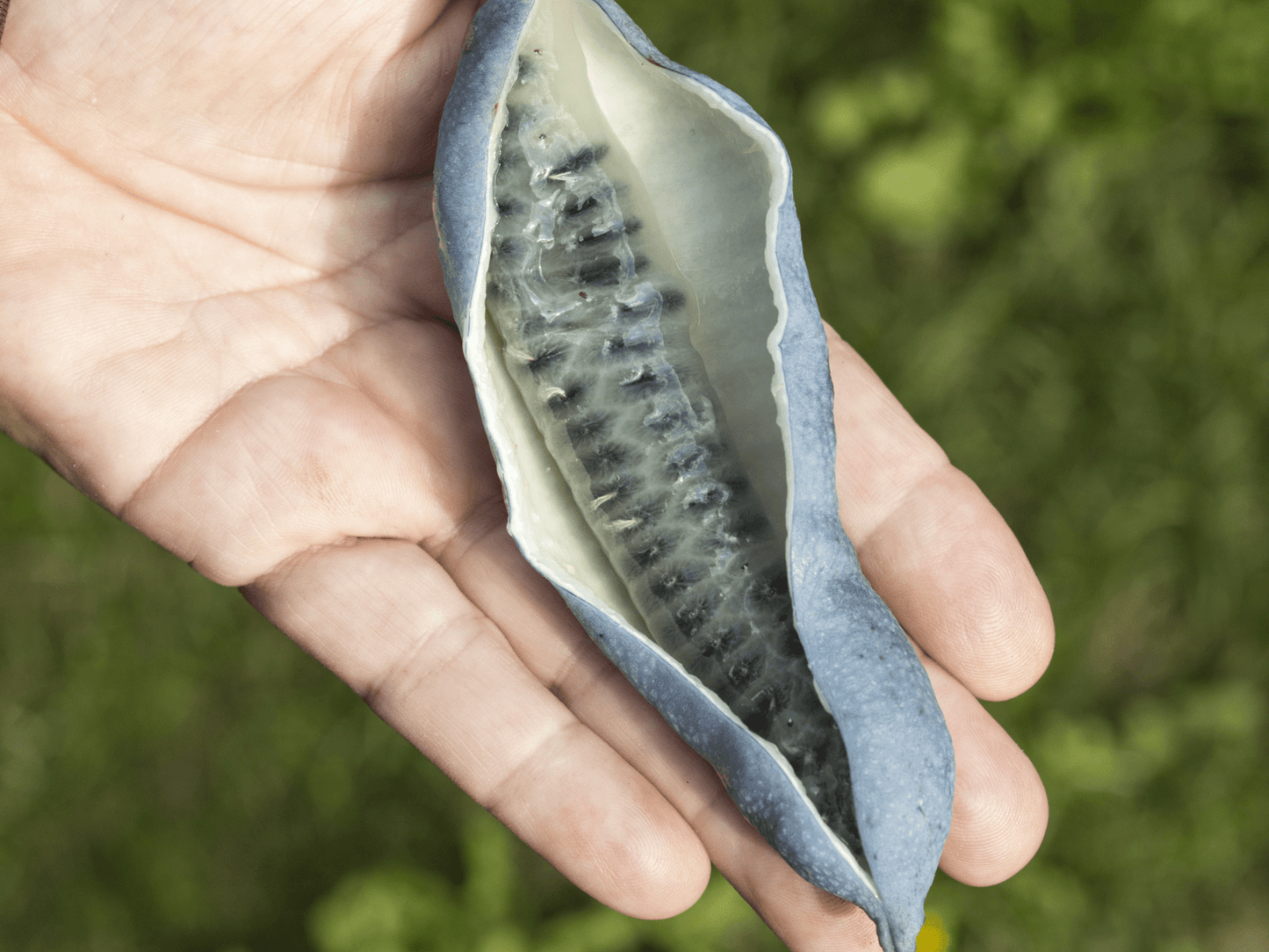
Decaisnea fargesii, the Blue Sausage Fruit or Dead Man's Fingers, is one of the most visually arresting plants available in temperate horticulture, producing metallic, iridescent blue seed pods in late summer and early fall that hang in drooping clusters from the branch tips and look so completely unlike anything else in a temperate garden that first-time observers consistently refuse to believe they are looking at a real plant. Each pod is 3 to 4 inches long, shaped like a thick, rounded sausage, and covered in a waxy blue coating with a silvery-metallic sheen that no photograph fully captures. Inside the fleshy pods is a row of black seeds embedded in a clear, sweet, gelatinous pulp that is edible with a mild, watermelon-like sweetness. Native to the mountain forests of western China and Nepal, it is one of the most distinctive temperate plants in cultivation and one of the easiest exotic plants to establish in temperate gardens across a wide range of climates. If you are looking to buy Blue Sausage Fruit seeds or grow this extraordinary plant from seed, this is the plant that creates more conversation per square foot than anything else in any garden it occupies.
- Metallic, iridescent blue sausage-shaped pods unlike any other fruit in the temperate garden
- Edible clear, sweet gelatinous pulp with a mild watermelon-like flavor surrounding black seeds
- Multi-stemmed shrub reaching 10 to 15 feet with large tropical-looking compound leaves
- Drooping clusters of small yellow-green flowers in late spring, unusual and ornamental in their own right
- Cold-hardy to zone 5, performing across a wide range of temperate climates
Things you probably did not know about the Blue Sausage Fruit
The plant was collected by the same French missionary who discovered the Giant Panda. Père Armand David, the 19th century French Lazarist missionary who was the first westerner to scientifically document the Giant Panda and who has more plants named after him than almost any other person in botanical history, collected Decaisnea specimens in western China in the 1860s and 1870s. The species epithet fargesii honors Pierre Farges, another French missionary and botanical collector who also worked in western China and collected Decaisnea specimens. The discovery of the Blue Sausage Fruit is embedded in one of the most productive periods of western botanical exploration of China.
The blue color comes from a waxy coating that can be rubbed off. The metallic blue of the fruit pods is produced by a waxy epicuticular layer covering the surface, similar in principle to the waxy bloom on blueberries and plums but producing a more intensely metallic effect. This wax can be partially rubbed off with a finger, revealing a darker green or brownish surface beneath and dramatically demonstrating that the blue is a surface coating rather than pigmentation in the fruit skin itself.
It was used medicinally in traditional Chinese and Tibetan medicine. Decaisnea fargesii roots, bark, and fruit have been used in traditional medicine in the mountain regions of western China, Yunnan, and Tibet for various applications including fever treatment and as a general tonic. Modern pharmacological screening of Decaisnea extracts has identified alkaloid compounds with biological activity consistent with some of the traditional uses.
The plant produces both male and female flowers on the same plant and is self-fertile. Unlike many unusual ornamental plants that require cross-pollination or separate male and female plants, Decaisnea is self-fertile and a single specimen can produce a full fruit crop without requiring a second plant. This makes it practical even for small gardens where growing two plants for cross-pollination would be impractical.
Growing Details
- Botanical Name: Decaisnea fargesii
- Stratification: Required, 60 to 90 days cold moist stratification
- USDA Zones: 5 to 8
- Soil: Moist, well-drained, rich in organic matter, slightly acidic to neutral
- Light: Full sun to partial shade
- Height: 10 to 15 feet
- Spread: 8 to 12 feet
- Growth Rate: Moderate, 1 to 2 feet per year
Plant it where the September fruit display will be at eye level from a path or garden bench. The first time you see the metallic blue pods hanging in a cluster you will understand why this plant has a cult following among gardeners who know it.
FAQ
FAQ
Do you pre-stratify the seeds?
Most of our seeds are not pre-stratified. They are stored under dry, cold conditions to preserve viability without initiating stratification, allowing you to time germination for your local growing season.
The exception is recalcitrant seeds. Because these seeds must remain moist to stay viable, they are kept in moist, cold storage and are therefore in a pre-stratified state. Depending on how long a particular batch has been stored, some may arrive with an emerging radicle and be ready to plant immediately. Radicle development is not guaranteed.
Please refer to the individual product page and included growing instructions for species-specific requirements.
Do any of your seeds need to stay moist? (Recalcitrant seeds)
Yes. Some species we offer, including Chestnut, Hazelnut, and Paw Paw, are recalcitrant and must remain moist to stay viable.
Please refrigerate these seeds immediately upon arrival unless they have already developed a radicle. Seeds with an emerging radicle should be planted promptly.
Do you ship internationally?
No. We currently ship within the United States only.
We previously shipped to Canada, but tariffs, duties, and import fees resulted in customers receiving significant and unpredictable additional charges upon delivery. Because we cannot reliably calculate or absorb these costs, we have suspended shipping to Canada.
At this time, we do not ship to Canada or other international destinations.
Shipping & What's Included
Shipping & What's Included
Shipping & Packaging
• Hand-packed in resealable kraft paper seed bags
• Stratification and planting instructions included on every seed pack
• Ships within 3–5 business days via USPS within the United States and U.S. territories
Return Policy
Return Policy
Due to the nature of our products, we do not accept returns on seeds.
If your order arrives damaged, contains incorrect items, or is missing items, please contact us within 7 days of delivery so we can resolve the issue.