

American Witch Hazel Tree Seeds (Hamamelis virginiana)
American Witch Hazel Tree Seeds (Hamamelis virginiana)
The last thing to bloom in fall. The first medicine from the forest.
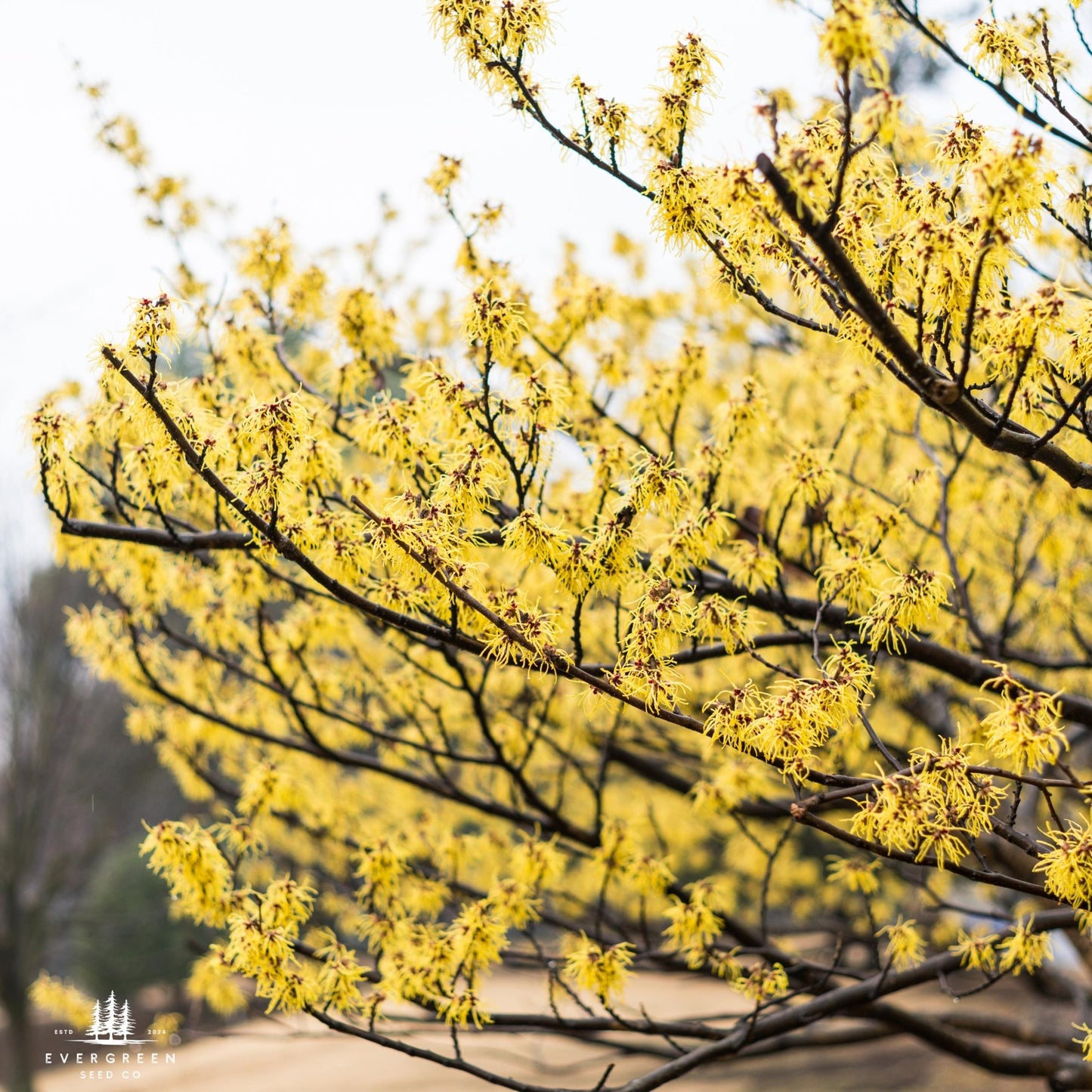
Hamamelis virginiana, the American Witch Hazel, blooms in November and December after every other tree has dropped its leaves, producing clusters of spidery, fragrant yellow flowers on bare stems at the exact moment when the rest of the landscape has surrendered to dormancy. It is the only woody plant in eastern North America that blooms in late fall, making it one of the most extraordinary and unexpected ornamental shrubs available to the temperate gardener. It is also the source of witch hazel extract, one of the oldest and most widely used botanical medicines in North America, present in medicine cabinets from colonial times to the present day. If you are looking to buy Witch Hazel seeds or grow this native shrub from seed, this is a plant that surprises everyone who encounters it blooming in November.
- The only woody plant in eastern North America that blooms in late fall and early winter on bare stems
- Spidery yellow flowers with a sweet, faintly spicy fragrance appearing after all other trees go dormant
- The original source of witch hazel extract, one of the oldest botanical medicines in North America
- Native to the eastern United States, adaptable to shade, sun, wet, and dry sites
- Brilliant yellow and orange fall foliage before the late-season blooms emerge
Things you probably did not know about the American Witch Hazel
The seeds are ejected ballistically up to 30 feet from the parent plant. When Witch Hazel seed capsules dry and contract in late fall, they build tension that is released explosively, launching seeds at speeds measured at over 30 feet per second. The seeds can travel 30 to 40 feet from the parent plant in a single ejection. This ballistic dispersal mechanism has been studied by mechanical engineers for its elegant natural spring design.
The witch in the name has nothing to do with witchcraft. The name derives from the Old English word wiche or wych, meaning flexible or pliant, describing the bendable quality of the branches. This same root gives us the wych elm of Britain. The name was applied to the American plant by early settlers who recognized the flexible branches as similar to Old World witch trees used for water dowsing, but the word itself is botanical, not supernatural.
Witch hazel extract has been in continuous commercial production since 1866. The Dickinson Company began steam-distilling Witch Hazel extract in Essex, Connecticut in 1866 and has been producing it continuously ever since from wild-harvested and cultivated Hamamelis virginiana. It is one of the longest-running commercially produced botanical medicines in American history and remains a standard ingredient in astringent skin products, aftershaves, and hemorrhoid treatments.
It blooms while carrying fruit from last year's flowers. American Witch Hazel takes a full year for its fruit to ripen after flowering. When the new November flowers open, the capsules from the previous year's flowering are simultaneously ripening and preparing to eject their seeds. A single branch in fall carries flowers, ripening seed capsules, and the leafless architecture of the shrub all at once.
Growing Details
- Botanical Name: Hamamelis virginiana
- Stratification: Required, warm stratification of 60 to 90 days followed by 90 days cold stratification
- USDA Zones: 3 to 8
- Soil: Adaptable, prefers moist, acidic, well-drained soil but tolerates a range of conditions
- Light: Full sun to partial shade
- Height: 15 to 20 feet
- Spread: 15 to 20 feet
- Growth Rate: Slow to moderate, 1 to 2 feet per year
Plant it where you will see it from a window in November. When everything else is gray and bare and the Witch Hazel is blooming, you will feel like you discovered something nobody else knows about.
FAQ
FAQ
Do you pre-stratify the seeds?
Most of our seeds are not pre-stratified. They are stored under dry, cold conditions to preserve viability without initiating stratification, allowing you to time germination for your local growing season.
The exception is recalcitrant seeds. Because these seeds must remain moist to stay viable, they are kept in moist, cold storage and are therefore in a pre-stratified state. Depending on how long a particular batch has been stored, some may arrive with an emerging radicle and be ready to plant immediately. Radicle development is not guaranteed.
Please refer to the individual product page and included growing instructions for species-specific requirements.
Do any of your seeds need to stay moist? (Recalcitrant seeds)
Yes. Some species we offer, including Chestnut, Hazelnut, and Paw Paw, are recalcitrant and must remain moist to stay viable.
Please refrigerate these seeds immediately upon arrival unless they have already developed a radicle. Seeds with an emerging radicle should be planted promptly.
Do you ship internationally?
No. We currently ship within the United States only.
We previously shipped to Canada, but tariffs, duties, and import fees resulted in customers receiving significant and unpredictable additional charges upon delivery. Because we cannot reliably calculate or absorb these costs, we have suspended shipping to Canada.
At this time, we do not ship to Canada or other international destinations.
Shipping & What's Included
Shipping & What's Included
Shipping & Packaging
• Hand-packed in resealable kraft paper seed bags
• Stratification and planting instructions included on every seed pack
• Ships within 3–5 business days via USPS within the United States and U.S. territories
Return Policy
Return Policy
Due to the nature of our products, we do not accept returns on seeds.
If your order arrives damaged, contains incorrect items, or is missing items, please contact us within 7 days of delivery so we can resolve the issue.