

Siebold Magnolia Tree Seeds | Oyama Magnolia| | (Magnolia sieboldii)
Siebold Magnolia Tree Seeds | Oyama Magnolia| | (Magnolia sieboldii)
The nodding white cups. The magnolia that blooms after the leaves.
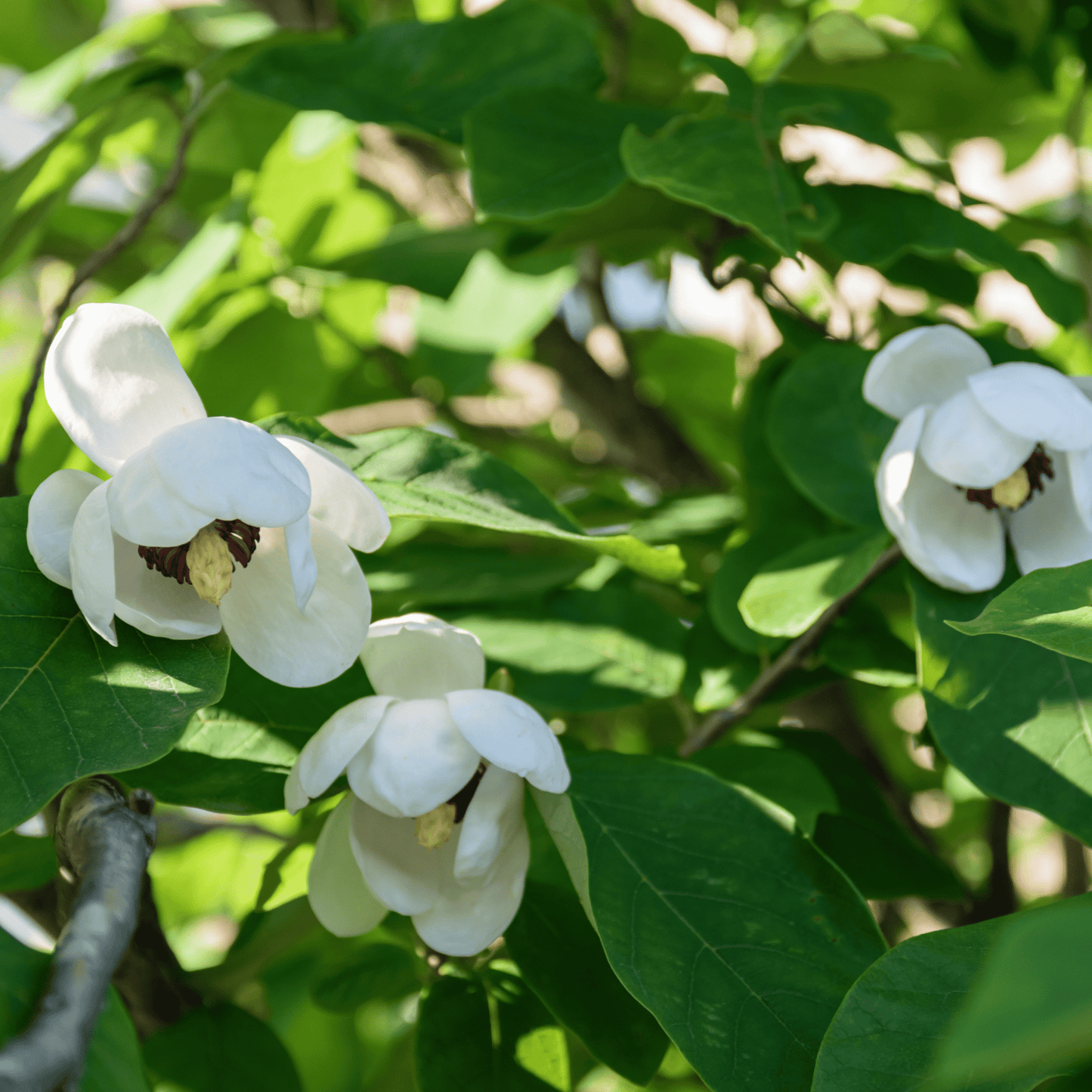
Magnolia sieboldii, the Siebold Magnolia or Oyama Magnolia, is the most refined and understated of the deciduous magnolias, producing pendant, cup-shaped white flowers with striking crimson stamens that hang downward on long stalks so that the full beauty of the flower interior can only be appreciated by looking up into the bloom from below or from a path running beneath the canopy. It blooms in late spring after the leaves have fully emerged, extending the magnolia season into early summer, and then continues producing scattered flowers through much of summer, giving it the longest effective bloom season of any deciduous magnolia. Named for Philipp Franz von Siebold, the German physician and botanist who introduced dozens of Japanese plants to western horticulture in the 19th century, it is grown by magnolia collectors worldwide for its delicate beauty and multi-season bloom. If you are looking to buy Siebold Magnolia seeds or grow this refined Japanese magnolia from seed, this is the magnolia worth approaching closely and looking up into.
- Cup-shaped white flowers with crimson stamens hanging pendant on long stalks, designed to be seen from below
- Blooms after leaves emerge and continues producing scattered flowers through much of summer
- The longest effective bloom season of any deciduous magnolia, from late May through July
- Compact form suitable for smaller gardens and woodland settings where larger magnolias are impractical
- Red-pink fruit cones in fall containing brilliant red seeds, ornamentally attractive through autumn
Things you probably did not know about the Siebold Magnolia
The pendant flower orientation is an adaptation to attract specific beetles for pollination. Magnolia flowers evolved before bees became the dominant pollinators and are primarily pollinated by beetles. The downward-hanging orientation of Siebold Magnolia flowers directs beetles that enter the flower downward into the floral chamber where pollen is concentrated, and the slight nodding makes it easier for beetles to exit with pollen attached. The crimson stamens that are visible in the center of the white petals serve as a landing target and nectar guide visible from a considerable distance.
It was the most frost-sensitive of the magnolias Sir Joseph Banks introduced from Japan to Kew Gardens. When Philipp von Siebold brought Magnolia sieboldii to Europe in the 1830s and specimens eventually reached Kew Gardens, it was noted as requiring more protection from late spring frost than most Japanese magnolias because of its relatively late bloom timing. The flowers, appearing when spring frosts are generally past, are actually less frost-vulnerable than early-blooming species, but the new foliage that emerges simultaneously is susceptible to late cold snaps.
The species has subspecies with slightly different characteristics across its range from Japan to Korea and China. Magnolia sieboldii grows naturally in the mountain forests of Japan, Korea, and northeastern China, with populations in different regions showing subtle differences in flower size, petal count, and leaf shape. Seed-grown plants from different geographic sources may express these regional variations, adding to the interest of growing from seed rather than from clonally propagated nursery material.
The red seeds are specifically adapted for bird dispersal. The brilliant red seeds that hang on threads from the opened fruit cones of Siebold Magnolia, like those of most magnolias, are designed to attract birds visually and offer a fat-rich coating that provides nutrition for the birds that consume and disperse them. The contrast between the red seeds and the white or tan cone background maximizes visual attractiveness to birds in the late summer forest.
Growing Details
- Botanical Name: Magnolia sieboldii
- Stratification: Required, 90 to 120 days cold moist stratification
- USDA Zones: 6 to 9
- Soil: Well-drained, moist, slightly acidic, rich in organic matter
- Light: Partial shade to full sun, best in dappled woodland light
- Height: 10 to 20 feet
- Spread: 10 to 20 feet
- Growth Rate: Slow to moderate, 6 to 18 inches per year
Plant it along a path you walk regularly in June and July so you will naturally look up into the hanging flowers. The crimson and white combination seen from below on a calm summer day is the entire point of this tree.
FAQ
FAQ
Do you pre-stratify the seeds?
Most of our seeds are not pre-stratified. They are stored under dry, cold conditions to preserve viability without initiating stratification, allowing you to time germination for your local growing season.
The exception is recalcitrant seeds. Because these seeds must remain moist to stay viable, they are kept in moist, cold storage and are therefore in a pre-stratified state. Depending on how long a particular batch has been stored, some may arrive with an emerging radicle and be ready to plant immediately. Radicle development is not guaranteed.
Please refer to the individual product page and included growing instructions for species-specific requirements.
Do any of your seeds need to stay moist? (Recalcitrant seeds)
Yes. Some species we offer, including Chestnut, Hazelnut, and Paw Paw, are recalcitrant and must remain moist to stay viable.
Please refrigerate these seeds immediately upon arrival unless they have already developed a radicle. Seeds with an emerging radicle should be planted promptly.
Do you ship internationally?
No. We currently ship within the United States only.
We previously shipped to Canada, but tariffs, duties, and import fees resulted in customers receiving significant and unpredictable additional charges upon delivery. Because we cannot reliably calculate or absorb these costs, we have suspended shipping to Canada.
At this time, we do not ship to Canada or other international destinations.
Shipping & What's Included
Shipping & What's Included
Shipping & Packaging
• Hand-packed in resealable kraft paper seed bags
• Stratification and planting instructions included on every seed pack
• Ships within 3–5 business days via USPS within the United States and U.S. territories
Return Policy
Return Policy
Due to the nature of our products, we do not accept returns on seeds.
If your order arrives damaged, contains incorrect items, or is missing items, please contact us within 7 days of delivery so we can resolve the issue.