

American Beech Tree Seeds | (Fagus grandifolia)
American Beech Tree Seeds | (Fagus grandifolia)
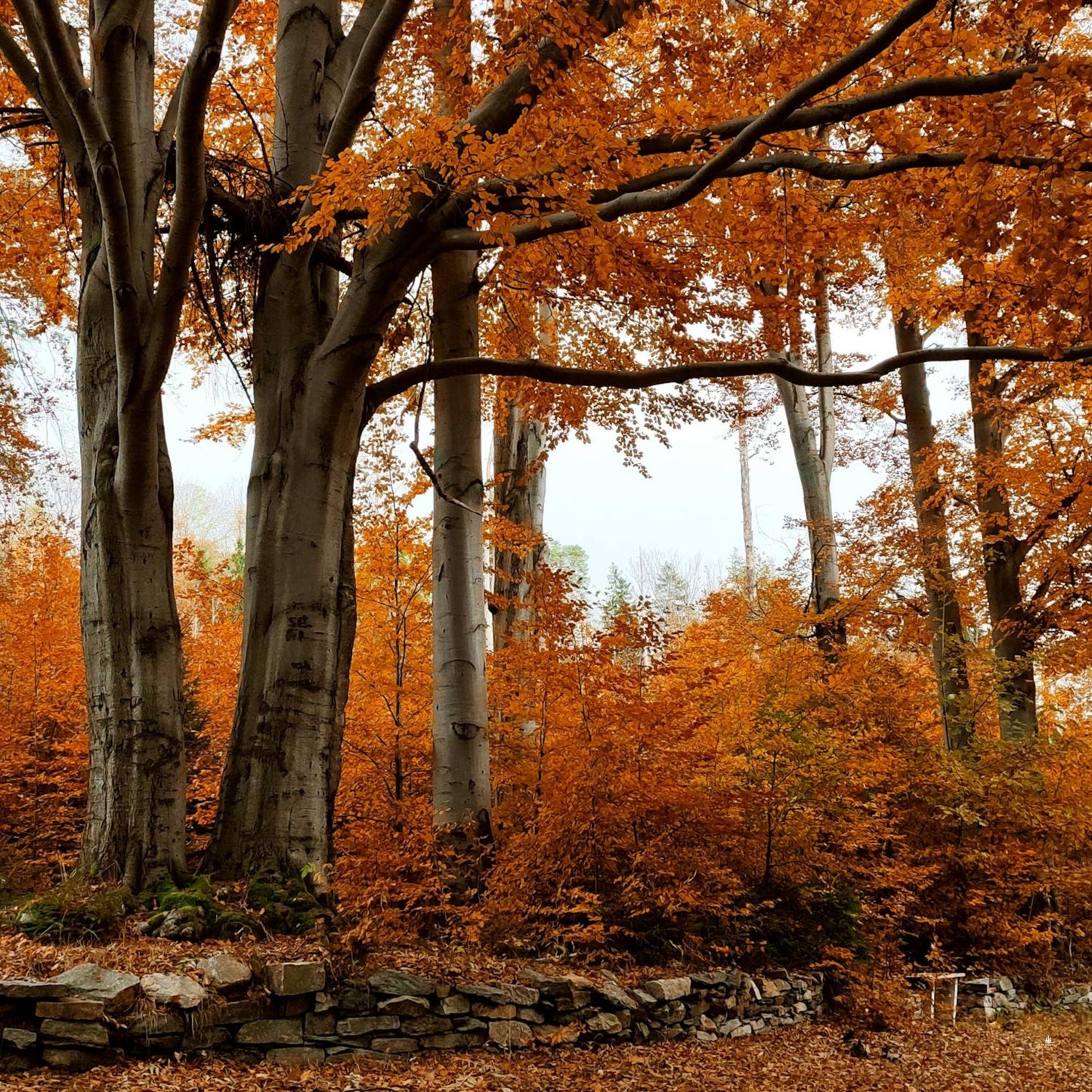
Silver bark. Golden fall. The tree that carries memory.
Fagus grandifolia, the American Beech, is the most graceful and architecturally beautiful native hardwood in eastern North America, with smooth silver-gray bark as distinctive as birch and far more durable, a dense canopy of dark green leaves that turn brilliant gold and copper in fall, and an ability to live and grow for centuries on the same site. It is the tree whose smooth bark has invited human inscription for generations, initials and dates carved into beech trunks sometimes surviving for over a hundred years in perfect legibility, a characteristic no other native tree shares. The American Beech is also under increasing pressure from beech leaf disease, a new and rapidly spreading disease that threatens populations across its range in the same way that Dutch elm disease and chestnut blight devastated their respective species. Growing American Beech from seed is an investment in the future of one of the most irreplaceable native trees in the eastern forest.
- Smooth silver-gray bark the most distinctive of any native hardwood, beautiful in every season
- Brilliant gold and copper fall color holding on the tree longer than most other hardwoods
- Beechnuts produced in spiny husks eaten by deer, bear, turkey, squirrel, and numerous songbirds
- Extremely long-lived, with documented specimens over 300 years old in undisturbed forest
- Currently threatened by beech leaf disease, making cultivation and preservation increasingly important
Things you probably did not know about the American Beech
Daniel Boone carved his name in a beech tree in 1760 and it was still legible in 1916. The smooth bark of American Beech holds carved inscriptions with remarkable durability because the bark does not cork over the wound the way other trees do. Carvings made in beech bark remain clear and legible for 50 to 100 years or more. The famous Daniel Boon cilled a bar inscription, with the misspelling of his own name that has puzzled historians for generations, was carved in a beech in Tennessee and remained readable for over 150 years.
It is one of the most shade-tolerant canopy trees in eastern North America. American Beech seedlings can survive in the deep shade of the forest floor for decades, growing slowly and waiting for a gap in the canopy. This extreme shade tolerance allows Beech to establish beneath other trees and eventually replace them as the canopy ages. In many northeastern forests, Beech-Maple associations represent the climax forest community, the most stable and self-replacing woodland type available in that region.
The beechnuts are a high-fat critical food source for fall migration. Beechnuts ripen in fall and are one of the highest-fat native mast foods available in the eastern forest. Black bears consume extraordinary quantities in preparation for hibernation. Wood ducks, ruffed grouse, wild turkey, and blue jays cache them and rely on them through winter. In mast years, the quantity of beechnuts produced by a mature forest can alter the population dynamics of multiple wildlife species simultaneously.
Beech leaf disease arrived in Ohio in 2012 and has spread rapidly. Caused by a nematode in the leaf tissue, beech leaf disease was first identified in 2012 and has since spread from the Great Lakes through New England and into Appalachia. Infected trees develop striped, leathery, distorted leaves and eventually die. The mechanism of spread and the full range of the disease are still being studied. Growing beech from seed preserves the genetic diversity of the species during a critical period.
Growing Details
- Botanical Name: Fagus grandifolia
- Stratification: Required, 90 days cold moist stratification, recalcitrant seed, keep moist
- USDA Zones: 3 to 9
- Soil: Well-drained, moist, slightly acidic, rich in organic matter
- Light: Full sun to full shade
- Height: 50 to 80 feet
- Spread: 40 to 80 feet
- Growth Rate: Slow, 6 to 12 inches per year when young, accelerating with age
Plant it in a spot you intend to keep for a long time. This is not a tree for temporary landscapes. It is a tree for places with a future.
FAQ
FAQ
Do you pre-stratify the seeds?
Most of our seeds are not pre-stratified. We ship them unstratified so you can control germination timing based on your local growing season. We sell to all 50 U.S. states and Canadian provinces, and since each region has different planting windows, pre-stratifying would risk seeds germinating in transit or before you're ready to plant.
True stratification requires cold, moist conditions, which can lead to premature sprouting or mold if not timed properly. To avoid this, we store most seeds in dry cold conditions to preserve viability — but this does not initiate stratification.
Do any of your seeds need to stay moist? (Recalcitrant seeds)
Yes — some species we offer are recalcitrant, meaning they must remain moist to stay viable and cannot be dried out. Examples include: Chestnut, Hazelnut, Paw Paw, etc.
These seeds are shipped in moist cold storage and are clearly labeled on the product page when applicable. Please refrigerate immediately upon arrival and follow included care instructions.
Do you ship internationally?
We currently ship to the United States and Canada only. Unfortunately, we cannot ship to other countries without a phytosanitary certificate, which is required by most international customs agencies.
If you're interested in shipping outside North America, please contact us. Note that a phytosanitary certificate typically adds $60–$80 USD per seed type and must be arranged in advance.
Shipping & What's Included
Shipping & What's Included
Shipping & Packaging
Hand-packed in resealable zipper kraft paper seed bags
Stratification and planting instructions included with every order
1 free bonus seed pack included with every order
Ships within 3–5 business days via USPS
Return Policy
Return Policy
Due to the nature of our products, we do not accept returns on seeds.
However, if your order arrives damaged or incorrect, please contact us within 7 days and we’ll make it right.